

Energy Audit Savings for Philippine Factories: Real Numbers
How Much Can a Philippine Factory Save After an Energy Audit? Real Numbers from Industrial Facilities
Meralco’s overall electricity rate for a typical household is ₱13.8161 per kWh Philstar.com, and industrial consumers — who often pay rates that include demand charges, power factor penalties, and other surcharges on top of the base generation rate — can find their effective per-kWh cost running even higher.
For a factory consuming 500,000 kWh per month, that translates to electricity bills well above ₱6,000,000 every single month. For a plant consuming 2,000,000 kWh monthly, the number crosses ₱20,000,000 — before accounting for penalties, demand charges, and other add-ons.
Against those numbers, the question that every factory owner and plant engineer should be asking is this: how much of that bill is waste — and how much of that waste can an energy audit find and permanently eliminate?
This article answers that question with real numbers. Not vague percentages. Not generic industry claims. Actual calculations — broken down by facility type, by system, and by the specific energy conservation measures (ECOs) that certified energy audits most commonly uncover in Philippine industrial settings.
By the end of this post, you will have a clear, peso-denominated picture of what an energy audit can realistically deliver for your facility — and why the cost of the audit itself is almost always the smallest number in the equation.
Why Philippine Factories Pay More Than They Should: The Hidden Waste Landscape
Before we get into the savings numbers, it is worth understanding why energy waste in Philippine industrial facilities tends to be so high to begin with. There are five structural reasons that consistently drive overconsumption in Philippine factories.
1. Aging Electrical Infrastructure The majority of manufacturing plants operating in Luzon today were built between the 1980s and early 2000s. The electrical infrastructure in many of these facilities — wiring, panel boards, transformers, and switchgear — was designed for a different era of technology and energy pricing. What was acceptable in 1995 is often deeply inefficient by 2026 standards.
2. No Submetering or Energy Visibility In many industrial facilities, energy monitoring systems are absent, and without real-time visibility into consumption, idle machinery and low power factor issues continue to cause silent, ongoing waste. Academia.edu Without knowing where your energy is going at the sub-system or department level, you cannot manage it effectively. Most Philippine factories operate with a single utility meter and very limited internal visibility into which production lines, departments, or equipment are the largest energy consumers.
3. Poor Power Factor The Energy Regulatory Board regulates utility rate schedules that penalize power factor lower than 85%. On the other hand, power factor higher than 85% is rewarded with a discount. BAHÁNDÍAN A large proportion of Philippine industrial facilities — particularly those with older motor-heavy equipment — operate at power factors significantly below 0.90, incurring monthly penalties that can represent 5% to 15% of their total electricity bill, month after month, year after year.
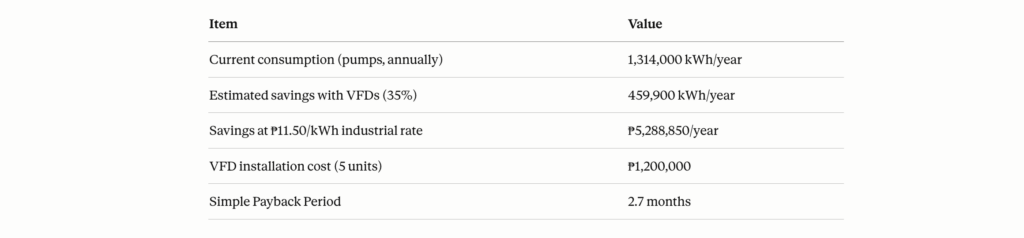
4. Outdated Motor Technology and No VFDs Electric motors are the single largest category of electricity consumers in most manufacturing facilities, accounting for 60% to 70% of total industrial electricity use globally. In Philippine factories, a large number of motors run continuously at full speed even when the process they are driving requires only partial flow or pressure. The installation of Variable Frequency Drives (VFDs) on variable-load applications is one of the most reliably impactful interventions identified in industrial energy audits.
5. Inefficient Lighting and HVAC Systems Energy auditing of Philippine facilities has consistently revealed that air conditioning accounts for approximately 51% of electricity consumption, equipment use for 35%, and lighting for 14% in commercial and institutional buildings. ResearchGate In industrial settings, lighting and HVAC proportions differ, but both remain significant sources of waste — particularly in facilities that have not yet transitioned from T8 fluorescent or metal halide lighting to LED, or that run air conditioning systems with dirty coils, refrigerant leaks, and incorrect temperature setpoints.
The Savings Potential by System: What Energy Audits Actually Find in Philippine Factories
Here is where the numbers get specific. Based on ETCZ Corp’s certified energy audit experience across Luzon industrial facilities, combined with documented industry data from Philippine energy efficiency programs and international industrial audit benchmarks, here is what each major energy system typically offers in terms of savings potential.
System 1: Power Factor Correction
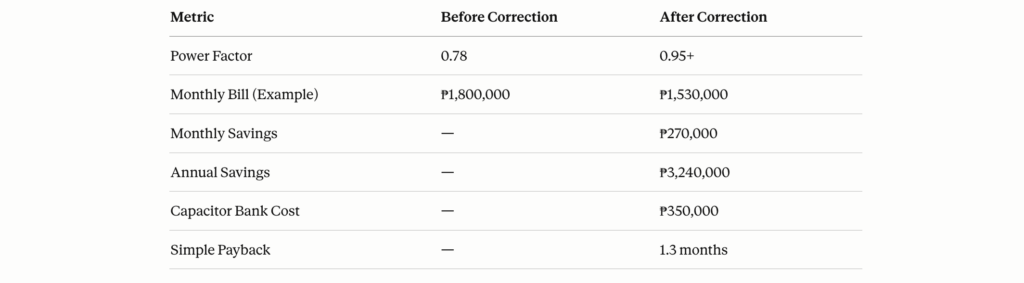
Typical Savings: 5% to 15% of total monthly electricity bill Investment Required: ₱80,000 to ₱500,000 (capacitor bank installation) Simple Payback: 3 to 12 months
Power factor correction is almost always the fastest-payback intervention identified in Philippine industrial energy audits. When your facility operates at a power factor below Meralco’s threshold, you are paying a penalty on every single kVA of reactive power your facility draws — and that penalty appears every month on your billing statement, whether you notice it or not.
Power factor penalties typically add 5% to 15% to commercial electric bills. On a ₱5,000 monthly bill, that is ₱250 to ₱750 in avoidable penalties monthly. Electricrates Scale that to a factory with a monthly electricity bill of ₱2,000,000, and the penalty surcharge alone is ₱100,000 to ₱300,000 per month — ₱1,200,000 to ₱3,600,000 annually.
The fix — installation of an automatic capacitor bank sized to your facility’s reactive power demand — corrects the power factor to 0.95 or higher, eliminating the surcharge entirely and often qualifying your facility for a power factor incentive credit from the distribution utility.
System 3: LED Lighting Retrofit
Typical Savings: 40% to 60% of lighting energy consumption Investment Required: ₱150,000 to ₱2,000,000 (depending on facility size) Simple Payback: 12 to 24 months
Lighting accounts for a smaller share of energy consumption in industrial facilities compared to commercial buildings — typically 5% to 15% of total electricity use — but the savings from LED retrofits are consistent, easy to implement, and require minimal ongoing maintenance.
In a typical Philippine factory with T8 or T5 fluorescent fixtures operating 16 to 24 hours daily, replacement with high-efficiency LED fixtures generates immediate, measurable electricity savings from day one of installation.
Scenario: Manufacturing Plant Warehouse and Production Area (500 fixtures)
HVAC and Refrigeration System Optimization
Typical Savings: 10% to 25% of HVAC/refrigeration energy Investment Required: ₱100,000 to ₱1,500,000 Simple Payback: 12 to 36 months
In Philippine commercial and industrial facilities, HVAC and refrigeration are among the largest electricity consumers — particularly in the dry season when ambient temperatures climb and cooling demand peaks. Meralco has noted that electricity demand increases by 20% to 33% during the dry season due to increased usage of cooling appliances. GMA News Online
Energy audits of HVAC and refrigeration systems typically uncover: refrigerant leaks causing compressors to work harder, dirty condenser and evaporator coils reducing heat transfer efficiency, incorrect temperature setpoints (facilities cooling below the required temperature without realizing it), lack of inverter technology on chillers and compressors, and absence of economy mode or setback schedules during non-production hours.
Even without capital investment — simply correcting setpoints, cleaning coils, and recharging refrigerant — HVAC and refrigeration savings of 10% to 15% are achievable in most Philippine industrial facilities.
Scenario: Cold Storage Facility with ₱800,000/month HVAC-Related Electricity Costs
| Measure | Investment | Annual Savings |
|---|---|---|
| Coil cleaning + refrigerant recharge | ₱80,000 | ₱480,000 |
| Setpoint correction (raise 2°C in unoccupied zones) | ₱0 | ₱384,000 |
| Inverter compressor retrofit | ₱1,200,000 | ₱1,920,000 |
| Total | ₱1,280,000 | ₱2,784,000 |
| Combined Payback | 5.5 months |
System 6: Electrical Panel Board and Distribution System Losses
Typical Savings: 2% to 8% of total electricity consumption Investment Required: ₱50,000 to ₱500,000 Simple Payback: 6 to 24 months
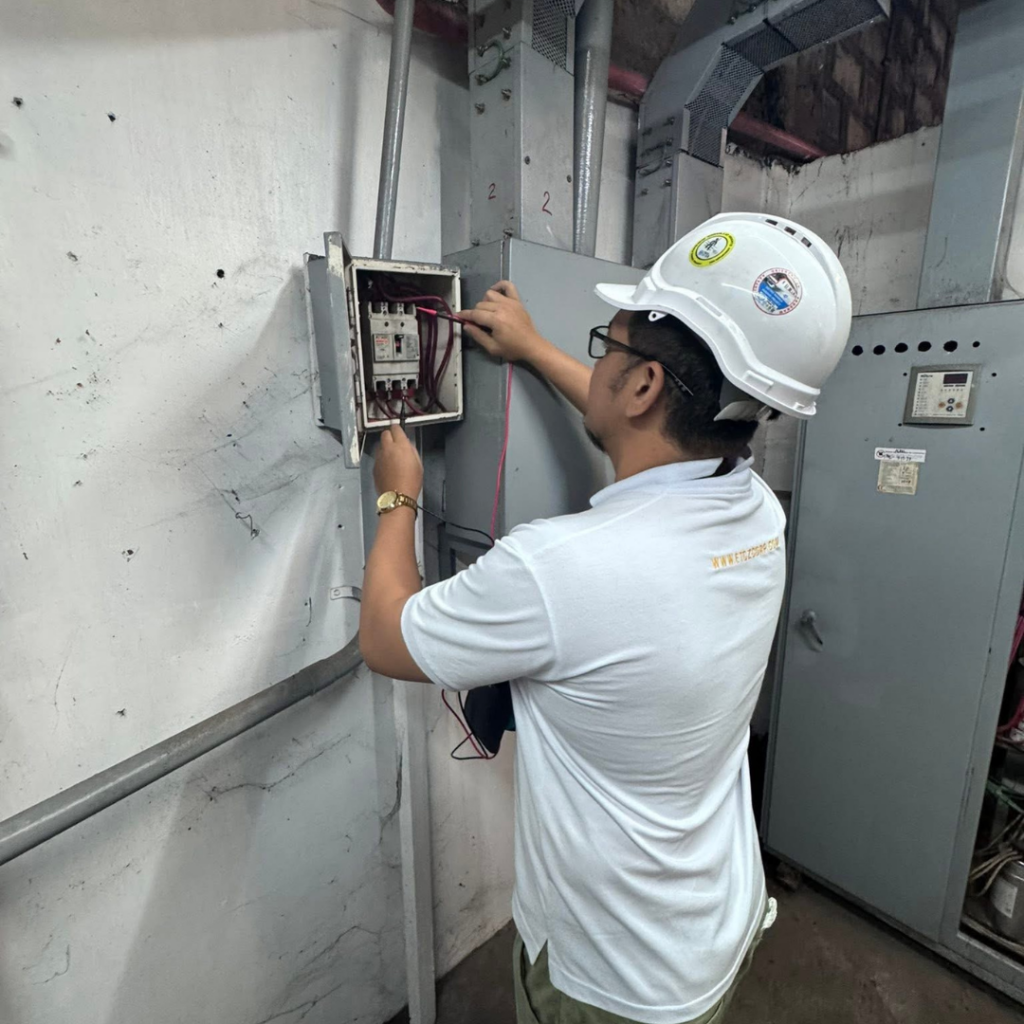
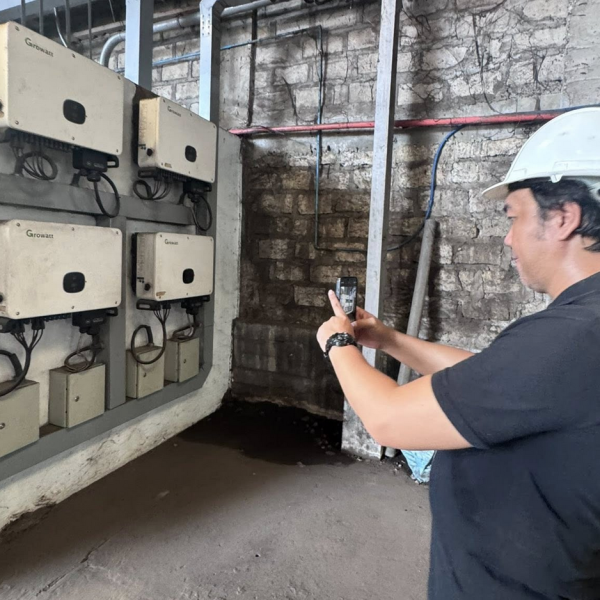
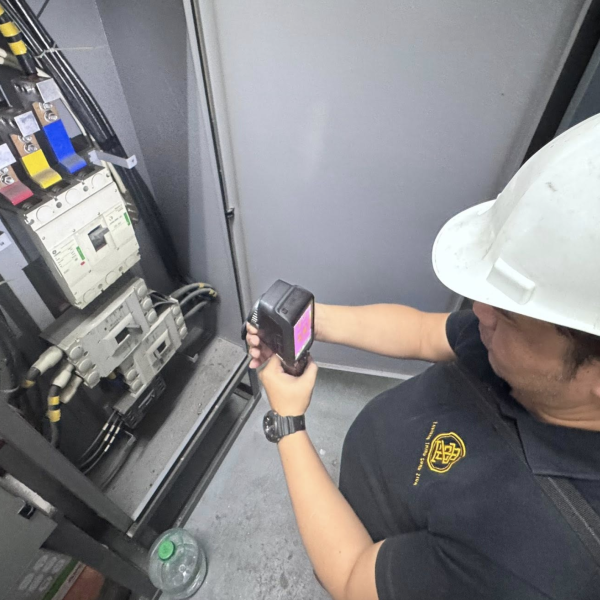
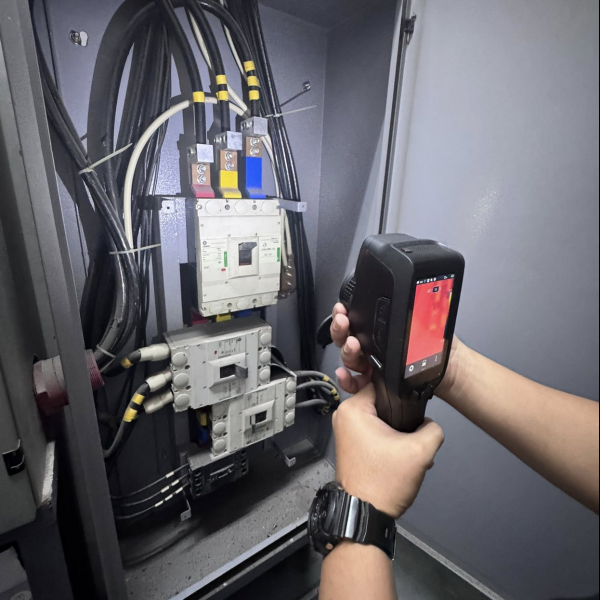
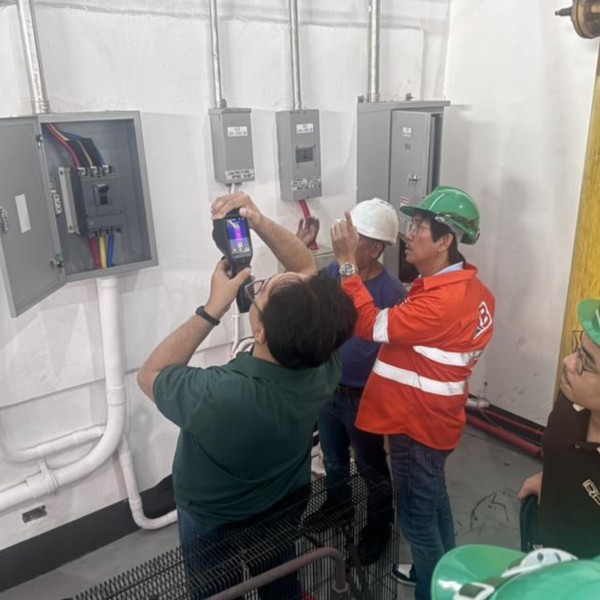
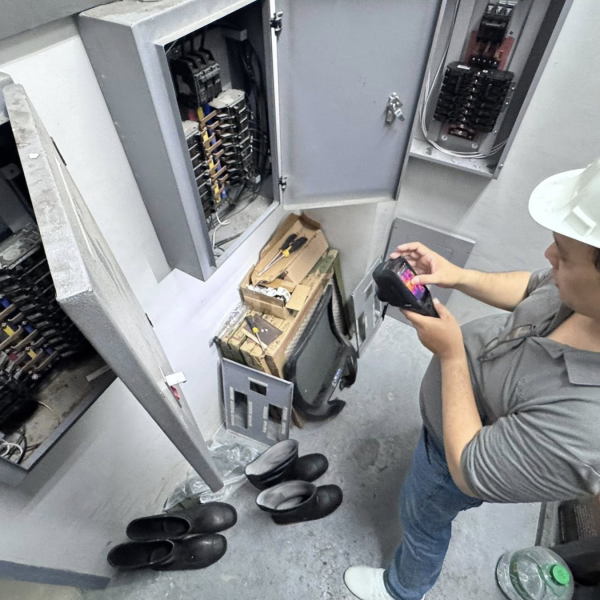
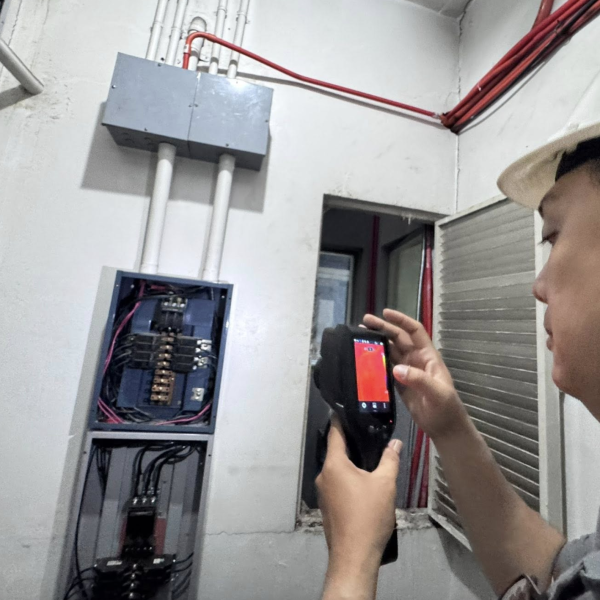
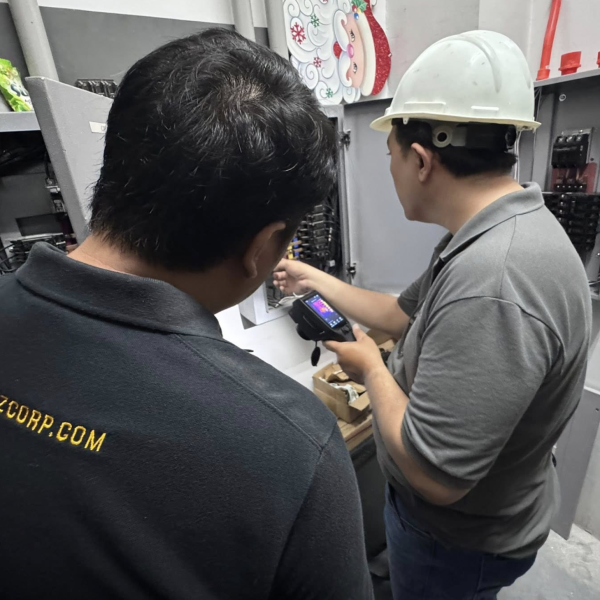
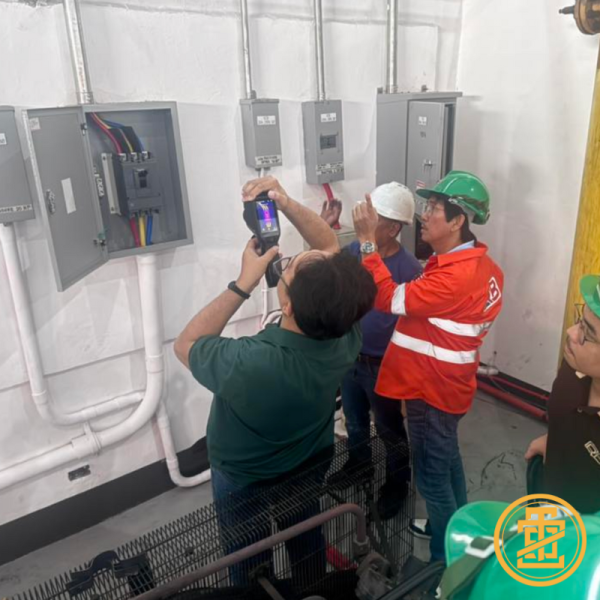
This is an area where ETCZ Corp’s unique combination of certified energy auditing and electrical thermography services delivers exceptional value. Electrical thermography — infrared scanning of panel boards, busbars, switchgear, and cable terminations — identifies hotspots caused by loose connections, overloaded circuits, corroded terminals, and aging wiring. These hotspots are not just fire hazards — they represent real energy losses, as electrical resistance in compromised connections converts electricity into heat rather than productive work.
A facility with 20 to 30 overheated panel connections (not unusual in a plant that has never had a thermography inspection) may be losing 1% to 3% of its total electricity consumption through resistive heating in its distribution system alone. In a facility with a ₱2,000,000 monthly bill, that is ₱20,000 to ₱60,000 in direct waste every month — on top of the elevated fire and equipment failure risk.
When combined with an energy audit, electrical thermography creates a powerful dual benefit: compliance-ready energy data and a safety inspection that protects your facility against electrical fires and equipment damage simultaneously.
Putting It All Together: Full-Facility Savings Scenarios
Now let us apply all of the above to realistic Philippine factory scenarios. Three facility types are profiled below, with conservative savings estimates based on ETCZ Corp’s audit experience and published Philippine energy efficiency program data.
Scenario A: Medium Manufacturing Plant (Rizal / Laguna)
Profile: Assembly or light manufacturing facility, 5,000 sqm production floor, 3 shifts, monthly electricity bill of ₱1,200,000, primarily motor and lighting load.
| ECO Identified | Annual Savings (₱) | Investment (₱) | Payback |
|---|---|---|---|
| Power factor correction (0.80 → 0.95) | ₱1,080,000 | ₱350,000 | 3.9 months |
| VFDs on 6 pump/fan motors | ₱2,160,000 | ₱900,000 | 5.0 months |
| LED lighting retrofit (300 fixtures) | ₱720,000 | ₱750,000 | 12.5 months |
| Compressed air leak repair | ₱540,000 | ₱120,000 | 2.7 months |
| Panel thermography + repairs | ₱216,000 | ₱80,000 | 4.4 months |
| Total | ₱4,716,000/year | ₱2,200,000 | 5.6 months |
Pre-audit annual bill: ₱14,400,000 Post-implementation annual bill (estimated): ₱9,684,000 Total savings: 32.7% reduction
Scenario B: Large Food Processing Plant (Laguna / Batangas)
Profile: Food manufacturing facility, 15,000 sqm, continuous production, monthly electricity bill of ₱3,500,000, heavy motor, compressed air, and refrigeration load.
| ECO Identified | Annual Savings (₱) | Investment (₱) | Payback |
|---|---|---|---|
| Power factor correction | ₱2,520,000 | ₱600,000 | 2.9 months |
| VFDs on 12 motors (pumps, conveyors, fans) | ₱7,560,000 | ₱2,400,000 | 3.8 months |
| LED retrofit (800 fixtures, 3 shifts) | ₱1,890,000 | ₱1,800,000 | 11.4 months |
| Compressed air optimization | ₱3,150,000 | ₱450,000 | 1.7 months |
| HVAC/refrigeration optimization | ₱2,520,000 | ₱1,200,000 | 5.7 months |
| Electrical distribution repairs | ₱630,000 | ₱200,000 | 3.8 months |
| Total | ₱18,270,000/year | ₱6,650,000 | 4.4 months |
Pre-audit annual bill: ₱42,000,000 Post-implementation annual bill (estimated): ₱23,730,000 Total savings: 43.5% reduction
Scenario C: Commercial-Industrial Mixed Facility / PEZA Zone Locator
Profile: Electronics assembly or light industrial facility in a PEZA-registered zone, 8,000 sqm, 2 shifts, monthly electricity bill of ₱2,000,000, mixed lighting, HVAC, process equipment load.
| ECO Identified | Annual Savings (₱) | Investment (₱) | Payback |
|---|---|---|---|
| Power factor correction | ₱1,440,000 | ₱420,000 | 3.5 months |
| VFDs on process equipment | ₱3,600,000 | ₱1,500,000 | 5.0 months |
| LED lighting full retrofit | ₱1,080,000 | ₱1,200,000 | 13.3 months |
| HVAC optimization | ₱1,440,000 | ₱900,000 | 7.5 months |
| Submetering installation | ₱288,000 | ₱300,000 | 12.5 months |
| Total | ₱7,848,000/year | ₱4,320,000 | 6.6 months |
Pre-audit annual bill: ₱24,000,000 Post-implementation annual bill (estimated): ₱16,152,000 Total savings: 32.7% reduction
The Hidden Multiplier: What Savings Compound Into Over 5 Years
One of the most important — and most commonly ignored — dimensions of energy audit ROI is the compounding effect of savings over time. An intervention that saves ₱3,000,000 per year does not save ₱3,000,000 for one year and then stop. It saves ₱3,000,000 every year — and because Meralco rates have a historical upward trend over time, the absolute peso value of those savings grows year over year even if the kWh reduction stays constant.
Meralco has implemented multiple rate adjustments in 2026 alone, reflecting the ongoing pressure of transmission costs, generation contract pricing, and ancillary service charges. Philstar.com Every upward rate adjustment amplifies the value of every kWh you no longer consume.
Using Scenario A (medium manufacturing plant, ₱4,716,000/year savings) and a conservative 3% annual electricity rate growth assumption:
| Year | Annual Savings (₱) | Cumulative Savings (₱) |
|---|---|---|
| Year 1 | ₱4,716,000 | ₱4,716,000 |
| Year 2 | ₱4,857,480 | ₱9,573,480 |
| Year 3 | ₱5,003,204 | ₱14,576,684 |
| Year 4 | ₱5,153,300 | ₱19,729,984 |
| Year 5 | ₱5,307,899 | ₱25,037,883 |
Against a total investment of ₱2,200,000 (with full payback achieved in under 6 months), the 5-year cumulative return exceeds ₱25,000,000. That is an 11:1 return on the energy efficiency investment — not counting the ₱80,000 to ₱150,000 audit cost, which is by far the smallest number in the entire equation.
Why the Energy Audit Cost Is Never the Limiting Factor
At this point, it should be clear that for any Philippine manufacturing or commercial-industrial facility consuming above 500,000 kWh per month, the cost of a certified energy audit is not a meaningful financial consideration relative to the savings it unlocks.
A well-structured phased approach — where quick wins like compressed air leaks and lighting are implemented first to generate early savings — can fund larger capital investments like VFDs in the following year, reducing financial risk and maintaining management support. CalcPanel
The real constraint is not the audit cost. It is the decision to act. Every month a facility operates without implementing the energy conservation opportunities identified in an audit is a month of preventable electricity expense. For a facility with ₱4,716,000 in annual savings potential, delay costs ₱393,000 per month.
What Determines How Much Your Specific Facility Can Save
While the scenarios above provide useful benchmarks, the actual savings potential for your facility depends on several variables that only a certified energy audit can quantify:
Current Power Factor: Facilities with power factors below 0.85 typically have the highest-payback opportunities. Facilities already at 0.95+ will see less here.
Motor Inventory and Operating Profiles: A facility with many variable-load pump and fan applications has greater VFD savings potential than one with primarily constant-speed, fixed-load processes.
Lighting System Age and Technology: Facilities still running T8 fluorescent or metal halide fixtures have significant LED retrofit opportunity. Facilities already retrofitted to LED have little additional savings here.
Compressed Air System Condition: Facilities that have never had a compressed air leak survey almost always have 20% to 40% savings potential in this system alone.
HVAC System Age and Maintenance History: Poor maintenance history and aging equipment signal significant savings potential. Well-maintained, recently upgraded systems have lower marginal opportunity.
Shift Pattern and Operating Hours: Facilities running 3 shifts have proportionally more savings potential from scheduling-related measures than 1-shift operations.
Last Energy Audit or Electrical PMS: Facilities that have never had a formal energy audit or electrical preventive maintenance inspection will almost always yield higher savings than those with recent maintenance histories.
The only way to get a facility-specific answer is to commission a certified energy audit — and the faster you do, the sooner the savings begin.
ETCZ Corp: Your Certified Energy Audit Partner Across Luzon
ETCZ Corp brings together certified energy auditors, licensed electrical engineers, thermography specialists, and installation teams under one roof — making us uniquely capable of taking your facility from audit findings to implemented, measurable savings.
When you engage ETCZ Corp for a certified energy audit, you receive:
- A full DOE-compliant certified energy audit report (EAR) — ready for submission to the DOE portal
- Detailed ECO analysis with peso-denominated savings calculations for each recommendation
- Power quality assessment including power factor and harmonics analysis
- Electrical thermography of your panel boards and distribution system
- A prioritized ECO implementation roadmap with payback calculations
- Energy Management Plan (EMP) and AEEIP for RA 11285 compliance
- Post-audit consultation and implementation support
We serve clients across Rizal, Laguna, Cavite, Batangas, Bulacan, Pampanga, and throughout Luzon — including factories in Laguna Technopark, Carmelray Industrial Park, First Philippine Industrial Park (FPIP), and PEZA-registered zones.
Call 09778411839 or email [[email protected]](mailto:[email protected]) to schedule your free preliminary assessment today. The sooner your audit is done, the sooner the savings start.
Lorem ipsum dolor sit amet, consectetur adipiscing elit. Ut elit tellus, luctus nec ullamcorper mattis, pulvinar dapibus leo.
Energy Audit Frequently Asked Questions
ETCZ Corp’s certified energy audit experience and Philippine DOE program data, Philippine factories that implement energy audit recommendations typically achieve electricity cost reductions of 15% to 43% in the first year, depending on the facility’s current efficiency baseline. For a factory with a monthly electricity bill of ₱2,000,000, a 25% reduction represents ₱6,000,000 in annual savings. The actual figure for your facility depends on its current power factor, motor and lighting technology, compressed air system condition, and HVAC maintenance history — all of which a certified energy audit will quantify.
Power factor correction consistently delivers the fastest payback — typically 3 to 12 months — in Philippine industrial facilities that currently operate below the 0.85 to 0.90 power factor threshold. This is because the savings are immediate (the penalty surcharge disappears from the first billing cycle after correction) and the installation cost of a properly sized capacitor bank is relatively modest. Compressed air leak repair is a close second, often delivering payback in 1 to 6 months.
Some measures — such as power factor correction, compressed air leak repair, and operational setpoint adjustments — can generate savings within 30 to 60 days of the audit report being delivered. Larger capital investments like VFD installations and LED retrofits typically take 2 to 6 months from recommendation to full implementation. Most Philippine facilities see their first measurable year-on-year electricity bill reductions within 3 to 6 months of receiving their certified energy audit report.
Gallery

Your Partner for Electrical Success
Whether you are looking to design a new system, optimize an existing one, or address specific challenges, ETCZ Corp’s electrical engineering services are your trusted solution. From initial planning to final implementation, we work closely with you to deliver efficient, reliable, and cost-effective results.

ETCZ Corp
Schedule Your Certified Energy Audit Today
If your facility requires a certified energy audit in the Philippines, work with professionals who understand both engineering and compliance. 👉 Book a FREE initial consultation with ETCZ Corp today. Our certified engineers will help you meet DOE requirements, reduce energy costs, and strengthen your electrical systems.

Call Now 09778411839
Have any queries?
We're here to help.
- #52 M.L Quezon St. Villa Ligaya Subdivision Barangay Dela Paz, Antipolo City
- 09778411839
- [email protected]