

How to Pass MERALCO Electrical Inspection in the Philippines: Complete Guide to Primary and Secondary Metering (2026)
Why Most MERALCO Inspection Failures Are Entirely Preventable
Failing a MERALCO electrical inspection is not just a bureaucratic inconvenience. It delays your project’s energization — sometimes by weeks. It forces costly rework on installations that were already plastered or painted over. And in the worst cases, it uncovers fire hazards that were never caught during construction because no licensed engineer reviewed the design.
MERALCO — the Manila Electric Company — is the Philippines’ largest private electricity distributor, serving over 6.8 million customers across Metro Manila, Rizal, Cavite, Laguna, Bulacan, Pampanga, Quezon Province, and parts of Batangas. Every single one of those customers — whether a family in Antipolo building their first home, a developer constructing a commercial plaza in Cainta, or a factory in Taytay expanding its production line — must pass a MERALCO service inspection before electricity is activated.
The inspection is not arbitrary. MERALCO inspectors follow strict technical standards anchored on the Philippine Electrical Code (PEC) — which adopts the NFPA 70 / National Electrical Code framework, co-published by the IIEE (Institute of Integrated Electrical Engineers) and the Bureau of Energy Efficiency under PRC — plus MERALCO’s own internal Distribution Standards, which govern everything from the acceptable types of conduit to the exact allowable height range of your kilowatt-hour meter.
At ETCZ Corp, our senior engineer spent 10 years as a MERALCO inspector in Rizal Province — personally conducting residential, commercial, and industrial service inspections across Antipolo, Cainta, Taytay, Angono, Binangonan, and beyond. He has seen every failure mode, every costly shortcut, and every installation detail that separates a first-attempt pass from an expensive rejection.
This guide shares exactly what MERALCO inspectors evaluate, why the most common failures happen, and what you must do before the inspector arrives. If you are building a new home, renovating a commercial space, or commissioning an industrial facility anywhere in MERALCO’s franchise area, this is the only MERALCO inspection guide you need.
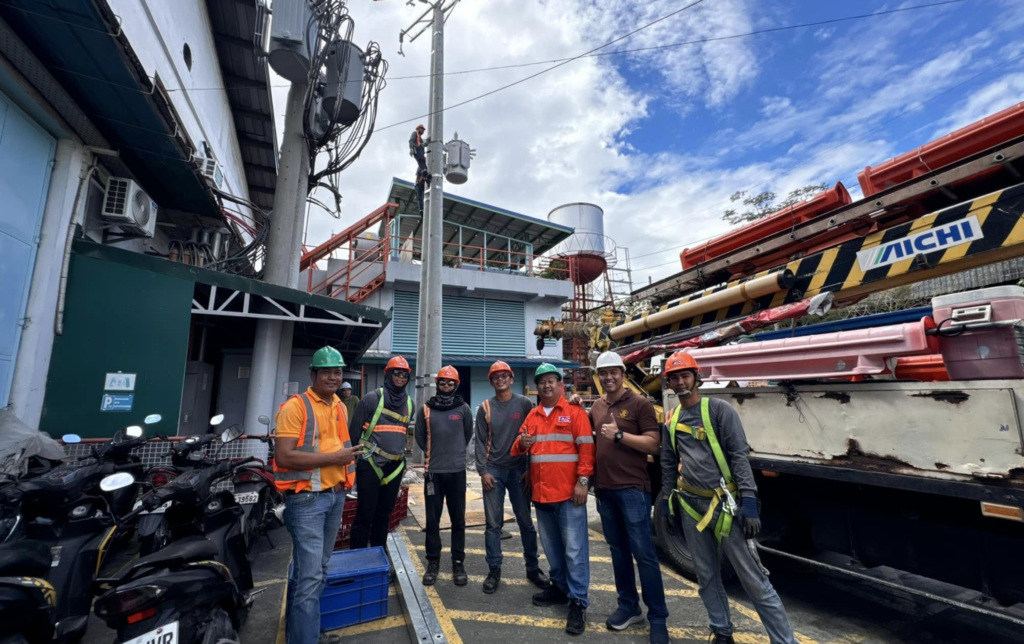
What Is a MERALCO Electrical Inspection — and What Does It Actually Cover?
A MERALCO electrical inspection is a technical field evaluation conducted by an authorized MERALCO inspector before the utility will energize a new service connection — or reconnect an existing service following major renovation, load expansion, or a change in metering type.
The inspection has two distinct components:
Component 1: The Service Entrance Installation
This covers everything from the weatherhead (service head) at the top of the conduit, through the service entrance conductors, conduit type and mounting, drip loop, meter base, to the main breaker or main disconnect. This entire installation is the property owner’s responsibility — MERALCO does not install it. The inspector evaluates whether it meets PEC and MERALCO Distribution Standards before authorizing meter installation.
Component 2: The Metering Equipment
MERALCO verifies that the meter base matches their current approved equipment list, that conductor terminations and polarity are correct, and that the installation is suitable for meter installation. For secondary metering, MERALCO then installs their kilowatt-hour meter. For primary metering, MERALCO seals and records the customer-owned CT/PT instrument meter.
What MERALCO Does NOT Inspect
This distinction is critical and often misunderstood by homeowners:
- Interior branch circuit wiring (outlets, switches, lighting circuits)
- The internal wiring of your load center or distribution panel
- Compliance with the architectural or structural electrical plan
Those elements are covered by the Local Government Unit (LGU) electrical inspection — conducted by the city or municipal engineer’s office — as part of the building permit and occupancy certificate process. That inspection is based on the approved electrical plan, which must be signed by a licensed PEE (Professional Electrical Engineer) for commercial and industrial projects, or an REE/ME (depending on LGU requirements) for residential projects.
You need both approvals. The LGU inspection is for your occupancy permit. The MERALCO inspection is for your power connection. They are parallel processes with separate agencies, separate documents, and separate timelines.
MERALCO Service Coverage: Is Your Property in Their Franchise Area?
| Region | Key Areas Served |
|---|---|
| Metro Manila | All 16 cities and Pateros municipality |
| Rizal Province | Antipolo City, Cainta, Taytay, Angono, Binangonan, Cardona, Morong, Baras, Jala-Jala, Pililia, Tanay, Teresa, Rodriguez (Montalban), San Mateo |
| Cavite | Bacoor, Imus, Dasmariñas, General Trias, Kawit, Noveleta, Rosario, Naic, Tagaytay, Trece Martires, and others |
| Laguna | Biñan, Calamba, San Pedro, Sta. Rosa, Cabuyao, Calauan, Los Baños, Bay, Nagcarlan, and others |
| Bulacan | Meycauayan, Marilao, Bocaue, Santa Maria, San Jose del Monte, and others |
| Pampanga | Apalit, Minalin, Sto. Tomas, San Simon, Mexico, Lubao (partial) |
| Quezon Province | Lucena City, Tayabas, Candelaria, Sariaya, Tiaong, and surrounding municipalities |
| Batangas | Select municipalities near Metro Manila periphery |
If your property is outside MERALCO’s franchise area, contact the relevant distribution utility (e.g., BATELEC I or II for parts of Batangas and Cavite, BENECO for Benguet). Their inspection standards differ from MERALCO’s.
The Single Most Important Decision Before You Wire Anything: Secondary vs. Primary Metering
Before your electrician pulls a single conductor, you must determine which metering type applies to your project. This decision drives every downstream specification — service entrance conductor size, conduit size, transformer requirement, metering equipment type, and total infrastructure cost.
Getting this wrong means redesigning and reinstalling major portions of your electrical system.
What Determines Your Metering Type?
The primary determinant is your contracted demand — the maximum power your facility requires at any given moment, measured in kilovolt-amperes (kVA).
| Metering Type | Typical Demand Threshold | Transformer Ownership | Meter Ownership |
|---|---|---|---|
| Secondary Metering | Below ~100 kVA | MERALCO | MERALCO |
| Primary Metering | ≥ ~100 kVA contracted demand | Property Owner / Customer | Property Owner (CT/PT instrument meter) |
The 100 kVA threshold is MERALCO’s general guideline. The actual determination is made by MERALCO after reviewing your submitted load computation and contracted demand application. Do not assume — submit your load data and confirm your metering type with MERALCO before finalizing your electrical design.
The vast majority of residential connections and small commercial spaces fall under secondary metering. Primary metering applies to large commercial buildings, hospitals, industrial plants, shopping centers, condominium developments, data centers, and any high-demand consumer whose continuous power requirements push into primary territory.
Secondary Metering: The Standard Connection for Homes and Small Businesses
Secondary metering is the default connection type for individual residences, small commercial establishments, and any facility whose contracted demand falls below MERALCO’s primary metering threshold.
How Secondary Metering Works
- MERALCO owns and operates the distribution transformer that steps high-voltage distribution current (typically 13.2 kV on MERALCO’s distribution feeders) down to utilization voltage (230V single-phase or 230/400V three-phase)
- MERALCO installs and owns the kilowatt-hour meter mounted on your approved meter base
- The property owner installs the service entrance — from the weatherhead through the conduit and conductors to the meter base to the main panel — at their own cost
- The distribution transformer is mounted on a utility pole (overhead system) or in a pad-mounted enclosure (underground system); MERALCO is solely responsible for its maintenance
Secondary Metering Connection Types
| Connection Type | Voltage | Phases | Wires | Typical Application |
|---|---|---|---|---|
| Single-Phase 2-Wire | 230V | 1 | 2 (Line + Neutral) | Standard residences, small commercial |
| Three-Phase 3-Wire (Delta) | 230V or 460V | 3 | 3 | Small industrial loads, motors |
| Three-Phase 4-Wire (Wye) | 230/400V | 3 | 4 (3 Lines + Neutral) | Commercial buildings, multi-load facilities |
The Philippines uses 230V as the standard utilization voltage at 60Hz, in accordance with ERC (Energy Regulatory Commission) standards and the Philippine Electrical Code. Legacy 110V installations exist in older structures but are no longer the standard for new connections.
Secondary Metering: Key Service Entrance Specifications
| Requirement | MERALCO Standard |
|---|---|
| Minimum conductor size | 5.5 mm² (10 AWG) copper for 30A service; scale up per ampacity (see table below) |
| Conductor insulation rating | THHN/THWN-2 or USE-2 rated; 75°C minimum |
| Conduit type | RMC (Rigid Metal Conduit) or IMC (Intermediate Metal Conduit) only |
| Conduit support | Secured to structure with approved clamps; maximum 1,800mm spacing |
| Weatherhead height | Minimum 600mm above point of attachment / roofline |
| Weatherhead orientation | Openings must face downward to prevent water ingress |
| Drip loop | Mandatory — minimum 300mm of slack loop from weatherhead opening |
| Meter height (center) | 1,200mm to 1,800mm above finished grade |
| Meter base type | MERALCO-approved list only |
| Main breaker | MERALCO-approved type, correctly sized for conductor ampacity |
Primary Metering: The High-Demand Connection for Commercial and Industrial Consumers
Primary metering is the connection type for large consumers whose contracted demand reaches or exceeds approximately 100 kVA. This is the connection used by shopping malls, hospitals, factories, large condominium developments, universities, and any other facility with substantial continuous power requirements.
How Primary Metering Works
- The customer owns, installs, and maintains the step-down transformer (or transformer bank) that steps MERALCO’s 13.2 kV distribution voltage down to the customer’s utilization voltage
- MERALCO connects at primary (high) voltage at the customer’s transformer primary terminals — MERALCO’s delivery point is on the high-voltage side
- The customer owns the CT/PT metering equipment — because the current and voltage magnitudes at 13.2 kV are far too high for direct measurement, current transformers (CTs) and potential transformers (PTs) are used to scale the measurements down to instrument levels
- The CT/PT metering set feeds a MERALCO-approved electronic multifunction instrument meter installed in a dedicated, lockable metering vault accessible to MERALCO inspectors and meter readers
- MERALCO seals the metering compartment after installation and records the meter for billing
Primary Metering Equipment — Customer Responsibility
| Equipment Component | Specification Requirement |
|---|---|
| Distribution Transformer | Oil-type or dry-type; kVA rating matched to contracted demand; BPS/PS Mark compliant |
| Primary Switchgear | Load-break switch or circuit breaker rated for 13.2 kV |
| Surge Arresters (Primary Side) | Rated for distribution voltage; required at transformer primary terminals |
| Current Transformers (CT) | MERALCO-approved accuracy class 0.3 or better; burden matched to meter |
| Potential Transformers (PT) | MERALCO-approved accuracy class 0.3 or better; burden matched to meter |
| Instrument / Multifunction Meter | MERALCO-approved electronic multifunction meter (revenue-grade) |
| Metering Vault / Compartment | Dedicated, lockable, with minimum clearances per MERALCO Distribution Standards |
| Transformer Vault (if indoor) | Fire-rated construction; oil containment pit for oil-type units |
| Grounding System | Separate equipment ground and transformer neutral ground; 10Ω or lower recommended |
| One-Line (Single-Line) Diagram | Signed and sealed by a licensed PEE; required for MERALCO application |
Primary Metering: MERALCO Distribution Voltage Reference
| Distribution Voltage | Primary Application | MERALCO Connection Point |
|---|---|---|
| 13.2 kV | Standard primary metering (most facilities) | Customer transformer primary terminals |
| 34.5 kV | Very large industrial, high-demand consumers | Bulk supply agreement; separate MERALCO process |
| 69 kV / 115 kV | Transmission level — NGCP grid connection | Not a MERALCO distribution connection |
Service Entrance Conductor Sizing: The Tables Every Electrician and Engineer Must Reference
Undersized service entrance conductors are the single most common technical reason for MERALCO inspection failure. The tables below are based on PEC ampacity values for 75°C-rated THWN copper conductors at 30°C ambient temperature — the standard Philippine baseline — and are aligned with MERALCO’s minimum service entrance requirements.
Single-Phase 230V Secondary Metering — Minimum Conductor Sizes
| Service Ampacity | Minimum Conductor (Cu) | Conduit Size (RMC/IMC) | Approx. Max Load (230V, 80% rule) |
|---|---|---|---|
| 30A | 5.5 mm² (10 AWG) | 19mm (¾”) | ~5.5 kW |
| 60A | 14 mm² (6 AWG) | 25mm (1″) | ~11.0 kW |
| 100A | 22 mm² (4 AWG) | 32mm (1¼”) | ~18.4 kW |
| 150A | 38 mm² (2 AWG) | 38mm (1½”) | ~27.6 kW |
| 200A | 60 mm² (1/0 AWG) | 51mm (2″) | ~36.8 kW |
| 300A | 100 mm² (3/0 AWG) | 63mm (2½”) | ~55.2 kW |
| 400A | 150 mm² (350 kcmil) | 76mm (3″) | ~73.6 kW |
Three-Phase 230/400V Secondary Metering — Minimum Conductor Sizes
| Service Ampacity (per phase) | Minimum Conductor (Cu) | Conduit Size (RMC) | Max 3-Phase Load (kW, 80%, PF 0.85) |
|---|---|---|---|
| 60A | 14 mm² (6 AWG) | 32mm (1¼”) | ~28.5 kW |
| 100A | 22 mm² (4 AWG) | 38mm (1½”) | ~47.5 kW |
| 150A | 38 mm² (2 AWG) | 51mm (2″) | ~71.3 kW |
| 200A | 60 mm² (1/0 AWG) | 63mm (2½”) | ~95.0 kW |
| 300A | 100 mm² (3/0 AWG) | 76mm (3″) | ~142.5 kW |
| 400A | 150 mm² (350 kcmil) | 100mm (4″) | ~190.0 kW |
Apply temperature correction factors for installation environments above 30°C (such as rooftop conduit runs under direct sunlight in the Philippine summer). Consult a licensed electrical engineer for derating calculations specific to your installation.
Internal Link Opportunity: For a complete Philippine AWG conductor sizing reference covering branch circuits, feeders, and motor circuits, see our Electrical Wire Size Chart Philippines: Complete AWG Guide →
Conduit Requirements: Why PVC Will Get You Rejected Every Time
The conduit requirements for service entrance installations are among the most strictly enforced MERALCO inspection points — and the most frequently violated by unlicensed or inexperienced electricians trying to cut costs.
Approved Conduit Types for MERALCO Service Entrance
| Conduit Type | MERALCO Acceptance | Notes |
|---|---|---|
| RMC — Rigid Metal Conduit (galvanized steel) | ✅ Accepted | Preferred; most durable; required for underground |
| IMC — Intermediate Metal Conduit | ✅ Accepted | Lighter wall than RMC; acceptable for exposed runs |
| EMT — Electrical Metallic Tubing (thin-wall) | ❌ Not accepted for service entrance | May be used inside structure; not on SE |
| PVC Schedule 40 or 80 | ❌ Not accepted for service entrance | Most common rejection cause |
| Flexible Metal Conduit (FMC) | ❌ Not accepted for service entrance | FMC is for equipment connections only |
Why PVC Is Not Allowed on Service Entrances
PVC conduit is widely used for interior branch circuit wiring in Philippine construction because of its low cost and ease of installation. However, on the service entrance — the run from the weatherhead to the meter base — MERALCO prohibits PVC for several critical reasons:
- Mechanical protection: The service entrance conduit is the most exposed portion of your electrical installation. It runs along an exterior wall, often at height, and is subject to UV degradation, physical impact, and thermal cycling. RMC and IMC provide significantly superior mechanical protection compared to PVC.
- Fire resistance: In the event of a fault on the service entrance conductors, metal conduit contains arcing better than PVC.
- Bonding and grounding: Metal conduit can be used as an equipment grounding conductor when properly installed with bonding fittings — PVC cannot serve this function.
- MERALCO Distribution Standards compliance: MERALCO’s internal standards specify metal conduit for service entrance, period. This is non-negotiable.
An electrician who quotes you a service entrance installation using PVC is either unaware of MERALCO’s standards or is deliberately cutting corners. Either way, the result is a failed inspection and a costly reinstallation.
MERALCO Meter Base Requirements: What “MERALCO-Approved” Actually Means
The meter base — also called the meter socket — is the mounting assembly that receives MERALCO’s kilowatt-hour meter. It is the physical interface point between your electrical installation and MERALCO’s metering infrastructure, which is why MERALCO is extremely specific about which meter bases are acceptable.
The Approved Meter Base Requirement
MERALCO does not accept just any commercially available meter base. Only units appearing on their current approved meter base list are accepted for installation. This list is maintained by MERALCO’s technical standards department and is updated periodically as new models are approved and outdated models are delisted.
A meter base approved two years ago may no longer be on the list today. Always confirm with your nearest MERALCO Business Center — or request confirmation through your licensed electrical contractor — before purchasing a meter base.
Meter Base Jaw Configuration by Service Type
| Service Type | Meter Jaw Configuration | Common Configuration |
|---|---|---|
| 1-Phase, 2-Wire (standard residential) | 2-jaw socket | Most common residential configuration |
| 3-Phase, 4-Wire Wye (commercial) | 7-jaw socket | Used with 3-phase electronic multifunction meters |
| 3-Phase, 3-Wire Delta | 4-jaw socket | For delta-connected three-phase services |
| Primary Metering (CT/PT type) | Instrument grade socket | High-accuracy class; separate from distribution socket |
Meter Base Physical Installation Requirements
| Installation Requirement | MERALCO Standard |
|---|---|
| Mounting surface | Vertical, flat, non-combustible: concrete wall, CHB, or metal framing |
| Height — center of meter | 1,200mm to 1,800mm above finished grade (ground level) |
| Mounting stability | No wobble, tilt, or flex when the meter is inserted or removed |
| Accessibility | Unobstructed access for MERALCO meter reader and inspector; no locked gates without provision for reading |
| Weather protection | Meter canopy or approved meter hood required for outdoor unenclosed installations |
| Conduit entry | Bottom entry preferred; watertight connectors required at all conduit entries |
| Gas line clearance | Minimum 300mm horizontal clearance from gas meters or gas supply lines |
| Conductor exposure inside meter base | Maximum 150mm (6 inches) of conductor exposed inside the meter base enclosure |
| Termination torque | Per manufacturer’s specification — both over-tightening and under-tightening are rejection items |
Grounding System Requirements: The 25-Ohm Rule and Why It Matters
Proper grounding is the most safety-critical aspect of any electrical installation — and it is rigorously verified during MERALCO inspection. A grounding system that fails to meet the 25Ω maximum resistance requirement is a direct rejection, and it is a problem that can be expensive and time-consuming to remediate if discovered at inspection time rather than during installation.
Grounding System Specifications
| Component | MERALCO / PEC Requirement |
|---|---|
| Ground rod material | Copper-clad steel |
| Ground rod diameter | Minimum 16mm (5/8 inch) |
| Ground rod length | Minimum 2.4 meters (8 feet) |
| Ground rod installation | Driven vertically into earth; full depth |
| Number of ground rods | Minimum 1; additional rods required if resistance exceeds 25Ω |
| Maximum ground resistance | 25Ω (measured with calibrated earth resistance tester) |
| Grounding electrode conductor (GEC) material | Bare or green-insulated copper; no aluminum for direct-burial |
| GEC minimum size (30A service) | 5.5 mm² (10 AWG) copper |
| GEC minimum size (60A service) | 8 mm² (8 AWG) copper |
| GEC minimum size (100A service) | 14 mm² (6 AWG) copper |
| GEC connection to ground rod | Listed grounding clamp or exothermic weld (Cadweld) — no wire-twist connections |
| GEC connection at main panel | Bonded to neutral bus and equipment ground bus — at main panel only |
| GEC physical protection | Protected by conduit from main panel to within 600mm of ground rod entry point |
| Main panel bonding | Neutral bus and equipment ground bus bonded together at the service disconnect (main panel only — not at sub-panels) |
When a Single Ground Rod Is Not Enough
If a single ground rod’s measured earth resistance exceeds 25Ω, you have several compliant remediation options:
| Option | Method | Best For |
|---|---|---|
| Additional ground rod | Drive a second rod at least 1.8m from the first; connect in parallel | Most common solution |
| Ground plate electrode | Install a copper ground plate buried at depth | Compact sites with space constraints |
| Ground ring | Bare copper conductor buried in a ring around the structure perimeter | Large buildings, high-resistivity soil |
| Chemical Ground Enhancement Material (GEM) | Mix with soil around ground rod to reduce soil resistivity | Rocky, dry, or high-resistivity soil |
| Deeper installation | Drive rod beyond 2.4m into lower-resistivity soil layers | Where shallow soil is highly resistive |
Critical note for Rizal Province installations: Antipolo City, Tanay, Jala-Jala, and elevated areas of Rizal Province sit on volcanic rock substrate with highly variable and often high soil resistivity. Ground resistance testing before you pour your concrete or finalize your landscape is strongly recommended. Discovering a 90Ω ground resistance after your perimeter fence is up and your garden is planted makes remediation significantly more difficult and expensive.
The MERALCO Service Application Process: Step by Step
Knowing the inspection checklist is necessary but not sufficient — you also need to navigate MERALCO’s application and scheduling process correctly. Documentation errors or process missteps add weeks to your timeline without any installation work being done.
Step 1: Complete Your Service Entrance Installation
Before approaching MERALCO, your licensed electrical contractor must complete:
- Full service entrance installation (weatherhead, RMC/IMC conduit, SE conductors, meter base, main breaker)
- Grounding system installation (ground rod, GEC, bonding at main panel)
- Main panel and all interior electrical work required for occupancy permit purposes
Step 2: Secure All Required Documents
| Document | Details |
|---|---|
| MERALCO Service Application Form | Available at MERALCO Business Centers or meralco.com.ph |
| Valid Government-Issued ID | Passport, UMID, driver’s license, PRC ID, or equivalent |
| Proof of Property Ownership / Authority to Connect | TCT, tax declaration, deed of sale, or notarized lease with owner consent |
| Building Permit (new construction) | Issued by LGU; includes electrical permit |
| Electrical Installation Certificate (renovation) | Signed by licensed electrician, REE, or PEE |
| One-Line Diagram (three-phase / primary metering) | Must be signed and sealed by a licensed PEE |
| Load Computation (three-phase / primary metering) | Submitted for MERALCO to confirm correct metering type |
| Barangay Clearance | Required by some MERALCO Business Centers for new connections |
Step 3: Submit Application at the Correct MERALCO Business Center
MERALCO service applications are processed at the Business Center with jurisdiction over your property’s address. For Antipolo City and Rizal Province:
- MERALCO Antipolo Business Center — primary service center for Antipolo City
- MERALCO Cainta Business Center — serves Cainta, Taytay, and adjacent areas
Submitting at the wrong Business Center will require resubmission and adds processing delay.
Step 4: Pay Connection Fees and Deposits
After document review, MERALCO issues a billing statement for your connection fees. These typically include:
- New service connection fee (varies by service type)
- Meter deposit (refundable upon service termination)
- Line extension fee, if the nearest MERALCO distribution line must be extended to your property (can be zero to over ₱50,000 depending on distance and terrain)
Step 5: MERALCO Field Inspection
Once fees are settled, MERALCO schedules a field inspector to evaluate your service entrance and meter base installation. The inspector’s evaluation drives the go/no-go decision for meter installation and energization.
Step 6: Meter Installation and Energization
Following a passed inspection:
- For secondary metering: MERALCO installs and seals the kilowatt-hour meter on your approved meter base
- For primary metering: MERALCO seals and records the CT/PT instrument meter in your metering vault; both parties sign metering documentation
- Energization typically occurs within 1–3 business days of passed inspection for secondary metering; primary metering energization follows a separate energization protocol
Timeline Reference by Connection Type
| Connection Type | Typical Total Timeline (Application to Energization) |
|---|---|
| Single-phase residential (secondary, 30A–60A) | 5–10 business days (complete documentation, compliant installation) |
| Single-phase residential (higher ampacity) | 7–15 business days |
| Three-phase secondary metering (commercial) | 10–20 business days |
| Primary metering (new customer) | 30–90 business days or more (transformer, vault, and primary switchgear involved) |
| Line extension required | Add 15–60+ business days depending on scope |
The Complete MERALCO Inspection Checklist
Use this pre-inspection checklist as your quality control walkthrough before the MERALCO inspector arrives. Every item below is an actual evaluation point drawn from MERALCO’s service entrance inspection protocol.
Service Entrance: Weatherhead and Conduit
| Inspection Point | Compliant Standard | ☐ Pass |
|---|---|---|
| Weatherhead height above point of attachment | ≥ 600mm above roofline or attachment point | ☐ |
| Weatherhead openings face downward | Yes — prevents water from entering conduit | ☐ |
| Drip loop present in service drop | ≥ 300mm of slack at weatherhead opening | ☐ |
| Conduit type | RMC or IMC only — no PVC | ☐ |
| Conduit support / clamping | Clamps at max 1,800mm intervals on structure | ☐ |
| Conduit waterproof fittings | Watertight connectors at all entries | ☐ |
| No open knockouts in conduit or meter base | All unused openings sealed | ☐ |
Service Conductors
| Inspection Point | Compliant Standard | ☐ Pass |
|---|---|---|
| Conductor insulation type | THHN/THWN-2 or USE-2 rated | ☐ |
| Conductor size | Matched to service ampacity per PEC table | ☐ |
| Conductor color coding | Black (L1), Red (L2 if 3-phase), White/Gray (Neutral), Green/Bare (Ground) | ☐ |
| No splices inside conduit | No splices permitted inside service entrance conduit | ☐ |
| Conductor length at meter base | ≥ 300mm conductor available at termination points | ☐ |
Meter Base
| Inspection Point | Compliant Standard | ☐ Pass |
|---|---|---|
| Meter base model | Current MERALCO-approved list | ☐ |
| Meter base height (center) | 1,200mm – 1,800mm above finished grade | ☐ |
| Mounting surface — vertical and stable | No tilt; no flex; solid wall or strut mounting | ☐ |
| Meter base jaw condition | No corrosion, bending, cracking, or insulation damage | ☐ |
| Conductor terminations — polarity | Correct; line-to-line and line-to-neutral connections verified | ☐ |
| Conductor terminations — torque | Per manufacturer specification | ☐ |
| Meter accessibility | No permanent obstruction; meter reader can access without tools | ☐ |
| Meter canopy / hood | Present for outdoor unenclosed installation | ☐ |
Grounding System
| Inspection Point | Compliant Standard | ☐ Pass |
|---|---|---|
| Ground rod installed | 16mm × 2.4m copper-clad steel | ☐ |
| Ground rod — full depth driven | 2.4m vertical penetration | ☐ |
| GEC size | Appropriate for service ampacity | ☐ |
| GEC connection to ground rod | Listed grounding clamp or exothermic weld | ☐ |
| GEC connection to main panel neutral/ground bus | Bonded at main panel | ☐ |
| Ground resistance | ≤ 25Ω (MERALCO inspector may test on-site) | ☐ |
| GEC protection where exposed | In conduit from panel to near ground rod entry | ☐ |
Main Breaker and Panel
| Inspection Point | Compliant Standard | ☐ Pass |
|---|---|---|
| Main breaker type | MERALCO-approved MCB or MCCB | ☐ |
| Main breaker ampacity | Correctly sized — matches conductor ampacity | ☐ |
| Main panel neutral-ground bonding | Bonded at this panel (service disconnect) only | ☐ |
| Panel labeling | Circuit labels installed or provided | ☐ |
The 10 Most Common MERALCO Inspection Failure Reasons
Based on direct inspection experience covering thousands of residential, commercial, and industrial connections in Rizal Province, these are the most frequently encountered reasons for MERALCO service inspection rejection:
| Rank | Failure Reason | Frequency | Prevention |
|---|---|---|---|
| 1 | PVC conduit on service entrance | Very High | Specify RMC or IMC in contractor scope of work |
| 2 | Undersized service entrance conductor | High | Use sizing table; have a licensed engineer verify |
| 3 | Meter base not on MERALCO approved list | High | Confirm current approved list before purchase |
| 4 | Meter base height outside 1.2m–1.8m range | High | Measure from finished grade and mark before installation |
| 5 | Missing or inadequate drip loop | Medium-High | Ensure ≥300mm slack at weatherhead opening |
| 6 | Ground resistance > 25Ω | Medium-High | Test before inspection; add rods or treat soil |
| 7 | Weatherhead height below 600mm above roofline | Medium | Measure and verify before finalizing conduit run |
| 8 | Non-MERALCO-approved main breaker | Medium | Purchase only from approved equipment catalog |
| 9 | Incomplete documentation | Medium | Prepare full document set before scheduling |
| 10 | Splices or taps inside service entrance conduit | Low-Medium | All connections at panel or meter base only |
What a MERALCO Connection Costs: 2026 Budget Reference
Understanding the full cost of a MERALCO connection requires separating MERALCO’s own fees from the cost of the customer-owned electrical installation.
MERALCO Fees (Indicative — Confirm at Business Center)
| Fee Type | Typical Range | Notes |
|---|---|---|
| New service connection fee | ₱1,500 – ₱5,000+ | Varies by service type and location |
| Meter / metering equipment deposit | ₱1,500 – ₱5,000 | Fully refundable upon service termination |
| Line extension fee | ₱0 – ₱50,000+ | Applies when nearest MERALCO distribution line must be extended |
| Three-phase connection premium | Additional over 1-phase | Per MERALCO Distribution Services tariff |
| Primary metering application | Project-specific | Includes separate agreements; fees are significantly higher |
Property Owner’s Installation Cost (Customer Responsibility)
| Component | Typical 2026 Cost (Rizal Province) |
|---|---|
| Service entrance conductor — 5.5 mm² THHN (30A, per meter) | ₱45 – ₱75/m |
| Service entrance conductor — 14 mm² THWN (60A, per meter) | ₱140 – ₱225/m |
| RMC conduit, 25mm, per 3m stick | ₱350 – ₱550 |
| MERALCO-approved meter base, single-phase 60A | ₱1,200 – ₱2,500 |
| Weatherhead fitting and fittings | ₱500 – ₱1,200 |
| Grounding system (rod, GEC, clamps) | ₱800 – ₱2,500 |
| MERALCO-approved main breaker (60A) | ₱1,500 – ₱3,500 |
| Licensed electrical contractor labor | ₱3,000 – ₱15,000+ |
| Estimated total — residential 60A single-phase | ₱9,000 – ₱30,000 |
Three-phase connections, high-ampacity services, and primary metering installations carry significantly higher costs. Primary metering projects involving a customer-owned transformer, switchgear, metering vault, and CT/PT sets can range from ₱500,000 to several million pesos depending on kVA rating and facility scope.
10 Tips from a Former MERALCO Inspector in Rizal Province
Our senior engineer’s decade conducting service inspections across Rizal Province produced these hard-won, field-tested insights — things that are rarely written in any code book but that determine whether your installation passes or fails:
1. Rough in your meter base before the concrete sets.
If your meter base is going into a concrete or CHB wall, position and secure the meter box and conduit stub-out before pouring or plastering. Repositioning a meter base that is already encased in masonry is expensive and structurally damaging.
2. Never buy a meter base without confirming with MERALCO first.
The approved meter base list changes. A model that was approved in 2022 may have been delisted by 2025. A quick call or visit to the MERALCO Business Center before you purchase saves you the cost of a replacement and a re-inspection fee.
3. RMC vs. PVC is not a gray area.
Many electricians use PVC on service entrance work because it is cheaper and faster to cut. MERALCO inspectors have been rejecting PVC service entrances for decades. This will not change. Specify RMC or IMC in writing in your contractor’s scope of work.
4. Install a meter canopy even when it seems unnecessary.
A meter canopy protects the meter from direct rain and the meter base from UV degradation. Inspectors look favorably on installations that show attention to long-term maintenance. And it prevents the far more expensive scenario of a failed meter base due to water damage three years after installation.
5. Test your ground resistance before the inspector arrives — not after.
Rent or purchase an earth resistance tester. Testing after the inspection is already scheduled, and discovering a 90Ω result with your ground rod already fully driven and your concrete poured, leaves you with extremely limited remediation options. Test early, treat the soil if needed, drive additional rods before you landscape.
6. Leave extra conductor length at every termination point.
Leave at least 300–450mm of conductor beyond each termination point. If the inspector identifies a polarity reversal, a wrong conductor, or a termination issue, you need enough conductor to re-terminate. Short conductors leave no room for correction and may require a full conductor replacement.
7. Label every conductor clearly.
Mark your service conductors: L1, L2 (if three-phase), N (neutral), G (ground). An unlabeled three-phase installation slows the inspector and can result in a follow-up verification visit. On primary metering installations, full labeling is effectively mandatory.
8. Secure your conduit to a solid substrate.
Conduit that moves or sags when touched is a rejection item. Electrical tape holding conduit to a wood fascia board or a bamboo support is not a conduit clamp. Use listed metal conduit clamps on concrete, CHB, or structural steel.
9. Your main breaker ampacity must match your conductor — not exceed it.
A 60A service entrance conductor with a 100A main breaker means the conductor can be overloaded without the breaker tripping. This is an unsafe installation and a direct rejection point. The main breaker must be sized for the conductor’s rated ampacity, not the anticipated maximum load.
10. Have your complete document set physically present on inspection day.
Inspectors occasionally need to verify your building permit number, electrical permit, or address against their dispatch order. Keep originals or certified true copies of all documents at the site on the day of inspection. Missing documents can result in a rescheduled visit even if the installation itself is perfect.
ETCZ Corp: Your Advantage Is 10 Years on the Other Side of the Inspection
At ETCZ Corp, our experience with MERALCO inspections is not theoretical — it is firsthand.
Our senior engineer spent a decade as a MERALCO inspector in Rizal Province, personally evaluating thousands of residential, commercial, and industrial service connections across Antipolo, Cainta, Taytay, Angono, Binangonan, Tanay, and throughout the province. He has seen every failure mode, every compliant installation, and every gray area where the difference between a pass and a rejection comes down to details that are invisible to the untrained eye.
That perspective is now your competitive advantage.
ETCZ Corp provides the full technical stack for MERALCO-compliant service connections:
- ✅ Licensed PEE electrical engineering services — one-line diagram design, load computation, PEE signature and seal for primary metering and commercial projects
- ✅ Service entrance design and installation supervision — correct conduit type, conductor sizing, meter base selection, and main breaker specification the first time
- ✅ Ground resistance testing and grounding system design — including soil treatment and multi-rod configurations for high-resistivity Rizal Province soil conditions
- ✅ MERALCO application assistance — document preparation, Business Center coordination, and inspection scheduling support
- ✅ Primary metering project management — transformer sizing, switchgear selection, CT/PT specification, metering vault design
- ✅ Certified energy audit services — for facilities seeking to optimize their MERALCO billing after connection
- ✅ Free initial consultation — call us before you start to make sure your electrical design is MERALCO-ready from day one
📞 Don’t build and hope. Build with engineers who know exactly what MERALCO is looking for.
📍 ETCZ Corp — Antipolo City, Rizal Province | Serving Metro Manila and all Rizal Province areas
🌐 www.etczcorp.com | 🗓️ Book your free consultation today

Frequently Asked Questions
Secondary metering is the standard connection type where MERALCO owns the distribution transformer and installs a direct kilowatt-hour meter on your approved meter base. It applies to connections with contracted demand typically below 100 kVA — covering most residences and small commercial establishments. Primary metering applies to large consumers (approximately 100 kVA contracted demand and above) where the customer owns the step-down transformer and uses a CT/PT-based instrument meter, because direct metering at high voltage (13.2 kV) is not practical. Under primary metering, MERALCO’s delivery point is on the high-voltage (primary) side of the customer’s transformer, and the customer is responsible for all primary-side equipment including the transformer, switchgear, metering vault, and CT/PT sets.
MERALCO requires RMC (Rigid Metal Conduit) or IMC (Intermediate Metal Conduit) for service entrance installations because of superior mechanical protection, fire resistance, and UV durability compared to PVC. The service entrance is the most exposed portion of the building’s electrical system — running along an exterior wall, subject to physical impact, thermal cycling, and direct sunlight. Metal conduit also supports equipment grounding bonding continuity in ways that PVC cannot. Using PVC on the service entrance is one of the most common MERALCO inspection rejection causes in the Philippines, and it is an absolute requirement with no exceptions under MERALCO’s Distribution Standards.
MERALCO requires the center of the kilowatt-hour meter to be mounted between 1,200mm and 1,800mm above finished grade (ground level). A meter height outside this range — whether too high for the meter reader to read safely or too low for ergonomic reading — is a direct inspection failure point. This measurement is taken from the finish floor or grade at the base of the meter board, not from any intermediate platform. The 1.2m–1.8m range has been MERALCO’s standard for many years and is uniformly enforced across their service territory.
MERALCO requires a maximum ground resistance of 25 ohms (25Ω), measured at the grounding electrode using a calibrated earth resistance tester. If the measured resistance exceeds 25Ω, you must reduce it before MERALCO will approve the inspection. Standard remediation options include driving additional ground rods (minimum 1.8m apart, connected in parallel), applying Chemical Ground Enhancement Material (GEM) mixed with soil around the rod, installing a copper ground plate electrode, or — where soil conditions allow — driving rods deeper into lower-resistivity soil layers. In high-resistivity soil areas common in elevated Rizal Province (Antipolo, Tanay), pre-installation ground resistance testing is strongly recommended before finalizing your grounding design.
Clients



Gallery







Your Partner for Electrical Success
Whether you are looking to design a new system, optimize an existing one, or address specific challenges, ETCZ Corp’s electrical engineering services are your trusted solution. From initial planning to final implementation, we work closely with you to deliver efficient, reliable, and cost-effective results.

Talk to ETCZ Corp Today
Looking for a trusted commercial or industrial electrical contractor in Luzon? 👉 Book your FREE initial consultation with ETCZ Corp today. Our certified electrical engineers are ready to assess your facility and deliver safe, efficient, and future-ready electrical solutions. ETCZ Corp – Your Trusted Electrical Contractor in Luzon.

Call Now 09778411839
Have any queries?
We're here to help.
- #52 M.L Quezon St. Villa Ligaya Subdivision Barangay Dela Paz, Antipolo City
- 09778411839
- [email protected]