

THHN vs. THWN vs. XLPE: Which Cable Should You Use? (Philippines Market — 2026 Complete Guide)
Why Choosing the Wrong Wire Costs You More in the Philippines
If you’ve ever walked into a hardware store in Antipolo, Quezon City, or Makati City and asked for “electrical wire,” you’ve probably been met with a wall of rolls, colors, sizes, and confusing letter codes: THHN, THWN, THWN-2, XLPE, THW, TW — the list goes on. For homeowners, engineers, project managers, and electrical contractors across the Philippines, choosing the wrong cable type isn’t just a rookie mistake — it can be a costly, dangerous, and code-violating one.
Here’s the reality: the Philippines’ tropical climate — defined by extreme heat, monsoon-level humidity, salt-laden coastal air, and typhoon threats — places some of the harshest demands on electrical infrastructure in the world. A wire that performs flawlessly in a dry temperate region can fail catastrophically in Luzon, Visayas, or Mindanao. Electrical fires, frequent breaker trips, cable degradation, and non-compliance with the Philippine Electrical Code (PEC) are all consequences of choosing the wrong insulation type for your environment.
This guide breaks down the three most commonly used wires in Philippine construction and industrial projects: THHN, THWN, and XLPE. We’ll cover their technical specifications, ideal use cases, Philippine market pricing, and how each performs in the Philippine climate — so that by the end of this article, you’ll know exactly which wire to use for your next project.
Whether you’re wiring a residential home in Antipolo, a commercial building in BGC, or a manufacturing plant in Laguna, this guide is for you.
Table of Contents
- Understanding Wire Designations: What Do the Letters Mean?
- What is THHN Wire?
- What is THWN Wire?
- What is XLPE (XHHW-2) Cable?
- THHN vs. THWN vs. XLPE: Head-to-Head Comparison
- Philippine Electrical Code (PEC) Requirements for Wire Selection
- How the Philippine Climate Affects Your Wire Choice
- Application Guide: Which Wire for Which Project?
- Price Comparison in the Philippine Market (2025–2026)
- Common Mistakes Filipino Electricians and Contractors Make
- ETCZ Corp: Your Expert Partner for Electrical Wire Supply and Installation
- Frequently Asked Questions (FAQ)
- Conclusion: Make the Right Choice the First Time
1. Understanding Wire Designations: What Do the Letters Mean?
Before comparing these three cable types, it’s critical to decode their naming conventions. In the Philippines, wire designations largely follow the American National Electrical Code (NEC) and UL (Underwriters Laboratories) standards, which serve as the foundation for the Philippine Electrical Code (PEC).
Here’s your quick decoder:
| Letter | Meaning |
|---|---|
| T | Thermoplastic insulation |
| H | Heat-resistant (75°C) |
| HH | High Heat-resistant (90°C) |
| W | Water/moisture-resistant |
| N | Nylon-coated outer jacket |
| X | Cross-linked Polyethylene (XLPE) insulation |
| 2 | Second generation / upgraded rating |
So when you see THHN, it reads: Thermoplastic + HHigh Heat-resistant + Nylon-coated. And XLPE stands for Cross-Linked Polyethylene, a fundamentally different insulation chemistry compared to the PVC used in THHN and THWN.
Understanding these basics saves Filipino project managers thousands of pesos and prevents code violations during inspections.
2. What is THHN Wire? The Most Common Wire in Philippine Residential Projects
THHN (Thermoplastic High Heat-resistant Nylon-coated) is the most widely used building wire in the Philippines. Walk into any hardware store from SM Antipolo to TNTS Binondo, and you’ll find shelves lined with THHN wire in colors: black, white, red, blue, green, and yellow.
Technical Specifications of THHN Wire
| Specification | THHN Rating |
|---|---|
| Insulation Type | PVC (Polyvinyl Chloride) |
| Jacket | Nylon (Polyamide) |
| Temperature Rating (Dry) | 90°C |
| Temperature Rating (Wet) | 75°C (when dual-rated as THHN/THWN) |
| Voltage Rating | 600V |
| Conductor | Solid or stranded copper (99.99% pure copper) |
| Standards | UL 83, PNS, NEC Article 310 |
| Flexibility | Moderate |
| PEC Compliance | Yes |
Key Characteristics of THHN Wire
Heat Resistance: THHN wire can operate continuously in dry environments at up to 90°C — making it suitable for most Philippine residential and commercial applications where ambient temperatures regularly reach 35–42°C during the dry season.
Nylon Jacket: The nylon (polyamide) outer jacket gives THHN its characteristic toughness. This nylon coating provides resistance to abrasion, oil, gasoline, and mild chemicals — making it useful in mechanical rooms, garages, and light industrial settings.
PVC Insulation: The primary insulation layer is PVC (polyvinyl chloride), one of the most widely produced and cost-effective electrical insulation materials in the world. PVC offers good dielectric strength and fire resistance. However, it does have limitations: when PVC burns, it can emit toxic chlorine-based smoke.
Dual Rating (THHN/THWN): In modern Philippine construction practice, most THHN wire sold today carries a dual rating of THHN/THWN, meaning it’s approved for both dry and wet locations. This makes it highly versatile. Most major brands in the Philippines — including those available through trusted electrical contractors like ETCZ Corp — supply dual-rated THHN/THWN wire as standard.
Ideal Applications for THHN Wire in the Philippines
- Residential house wiring (branch circuits, lighting circuits)
- Low-voltage distribution from transformer to switchgear
- Motor control centers (MCC)
- Indoor conduit wiring in commercial buildings
- Machine tools and control circuits
- General building wiring per PEC Section 3.10
Limitations of THHN Wire
- PVC insulation can emit toxic smoke when burned — a concern in enclosed or poorly ventilated spaces
- Thinner jacket compared to XLPE means less protection against aggressive chemicals
- Under extreme heat or prolonged moisture exposure, PVC insulation can degrade faster than XLPE alternatives
- Current leakage risks are higher in demanding circuits where the thinner PVC jacket is stressed by environmental exposure
3. What is THWN Wire? The Water-Resistant Solution for Wet Philippine Environments
THWN (Thermoplastic Heat and Water-resistant Nylon-coated) is THHN’s moisture-specialist cousin. In the Philippines’ context, THWN becomes critically important because so much of the country’s electrical infrastructure is exposed to groundwater, flooding, and monsoon-driven moisture infiltration.
Technical Specifications of THWN / THWN-2
| Specification | THWN | THWN-2 |
|---|---|---|
| Insulation | PVC | PVC |
| Jacket | Nylon | Nylon (enhanced) |
| Temp (Dry) | 90°C | 90°C |
| Temp (Wet) | 75°C | 90°C |
| Voltage | 600V | 600V |
| Water Resistance | Yes | Yes (superior) |
| Standards | UL 83 | UL 83 |
The key upgrade of THWN-2 over standard THWN is its ability to maintain a 90°C temperature rating even in wet locations — a crucial specification for underground conduit runs in Metro Manila and flood-prone areas of Central Luzon.
How THWN Differs From THHN
The distinction between THHN and THWN is their moisture resistance. While both use PVC insulation over copper conductors and a nylon outer jacket, THWN is engineered with a moisture-rated formulation of PVC that maintains its insulating integrity when exposed to water over extended periods.
In practice:
- THHN is optimized for dry environments (air-conditioned interiors, enclosed raceways)
- THWN is designed for wet environments (outdoor conduits, underground runs, wet mechanical rooms)
- THWN-2 is the premium version rated for wet locations at 90°C — the current industry preference
In most modern Philippine construction projects, contractors specify THHN/THWN-2 dual-rated wire — a single wire type that satisfies both designations. This simplifies procurement, reduces errors, and ensures PEC compliance across all installation environments.
Applications of THWN Wire in the Philippines
- Underground conduit wiring in residential subdivisions and commercial properties
- Outdoor service entrances exposed to rain and humidity
- Wet mechanical rooms, pump houses, and utility areas
- Below-grade electrical installations in basements and parking structures
- Coastal and typhoon-prone installations where moisture ingress is expected
4. What is XLPE Cable? The Industrial Workhorse for the Philippine Market
XLPE (Cross-Linked Polyethylene) represents a fundamentally different approach to cable insulation compared to THHN and THWN. While the THHN/THWN family uses thermoplastic PVC, XLPE cables use a thermoset insulation — a material that undergoes an irreversible chemical change (cross-linking) during manufacturing that gives it superior thermal, electrical, and mechanical properties.
The most common XLPE wire type in Philippine industrial installations is designated as XHHW-2, where:
- X = Cross-Linked Polyethylene (XLPE) insulation
- HH = High Heat-resistant (90°C)
- W = Water-resistant
- 2 = Rated for 90°C in both dry and wet locations
Technical Specifications of XLPE Cable
| Specification | XLPE (XHHW-2) |
|---|---|
| Insulation Type | Cross-Linked Polyethylene (XLPE) |
| Jacket | XLPE thermoset |
| Temperature Rating (Dry) | 90°C |
| Temperature Rating (Wet) | 90°C |
| Voltage Rating | 600V / 1kV (dual rated) |
| Dielectric Constant | Lower than PVC (less leakage) |
| Chemical Resistance | Superior to PVC |
| Flexibility | Higher than THHN |
| Smoke Toxicity | Lower than PVC when burned |
| Standards | IEC 60502, UL 44, PNS |
The Science Behind XLPE’s Superiority
The “cross-linking” in XLPE refers to the creation of chemical bonds between polymer chains during the vulcanization process. This molecular transformation creates a three-dimensional network that is fundamentally more stable than the linear polymer chains of thermoplastic PVC. The result:
Higher thermal stability — XLPE maintains its insulating properties at elevated temperatures without softening or deforming, unlike PVC which can become plastic and flow under heat.
Superior dielectric properties — XLPE has a lower dielectric constant than PVC, meaning less electrical energy is lost to the insulation material itself. This reduces current leakage and improves energy efficiency in long cable runs.
Better flexibility — Paradoxically, despite being thicker and more protective, XLPE insulation is more flexible than PVC. This is because the cross-linked structure allows the polymer to bend and flex more freely than PVC’s rigid crystalline structure, making XLPE cable significantly easier to pull through conduits and cable trays during installation.
Chemical resistance — XLPE resists ozone, UV radiation, many acids, and alkalis — making it ideal for the aggressive chemical environments found in Philippine industrial facilities, chemical plants, and coastal installations.
Lower fire toxicity — XLPE does not contain chlorine (unlike PVC), so when it burns, it does not emit toxic hydrogen chloride gas. This is a major safety advantage in enclosed spaces like malls, hospitals, and high-rise buildings.
Applications of XLPE Cable in the Philippines
- PEZA economic zones and industrial parks in Cavite, Laguna, Batangas, and Clark
- Manufacturing plants and factories across Luzon
- Power feeders and main distribution panels in high-rise commercial buildings
- Underground medium-voltage distribution (3.3kV, 11kV, 33kV)
- Hospitals and healthcare facilities (Hospital Grade applications)
- Data centers and IT facilities
- Cold storage facilities requiring cables rated for extreme temperature cycles
- Solar PV and renewable energy installations
- Typhoon-resistant aerial bundled conductor (ABC) systems
5. THHN vs. THWN vs. XLPE: The Definitive Head-to-Head Comparison
Here is the comprehensive comparison that Filipino electrical engineers, contractors, and procurement managers need:
Full Technical Comparison Table
| Feature | THHN | THWN-2 | XLPE (XHHW-2) |
|---|---|---|---|
| Insulation | PVC | PVC | Cross-Linked Polyethylene |
| Outer Jacket | Nylon | Nylon | XLPE Thermoset |
| Max Temp (Dry) | 90°C | 90°C | 90°C |
| Max Temp (Wet) | 75°C | 90°C | 90°C |
| Voltage Rating | 600V | 600V | 600V / 1kV |
| Insulation Thickness | Thin | Thin-Medium | Thicker |
| Flexibility | Moderate | Moderate | Higher |
| Chemical Resistance | Good | Good | Excellent |
| Moisture Resistance | Moderate | High | Very High |
| UV Resistance | Low | Low | High |
| Fire Toxicity | Higher (chlorine in PVC) | Higher | Lower (no chlorine) |
| Current Leakage Risk | Higher | Moderate | Lower |
| Weight | Lighter | Lighter | Slightly heavier |
| Installation Ease | Easy | Easy | Easier (more flexible) |
| Initial Cost | Lowest | Low-Medium | Higher |
| Long-Term Value | Good | Good | Excellent |
| Conduit Fill | Smaller OD | Smaller OD | Larger OD |
| PEC Compliance | ✅ | ✅ | ✅ |
| Best for Philippines | Dry/Indoor Residential | Wet/Underground | Industrial/Commercial |
Key Takeaways from the Comparison
Cost vs. Longevity: THHN is the most affordable upfront, making it the go-to for Philippine residential projects with budget constraints. However, for commercial and industrial projects where downtime is costly, XLPE’s longer service life often makes it the more economical long-term choice.
Wet Location Superiority: For any installation exposed to moisture — which in the Philippines means virtually any outdoor installation — THWN-2 or XLPE is mandatory. Trying to use standard THHN in a flooded conduit is a recipe for insulation breakdown.
Chemical and Environmental Stress: In Philippine industrial environments — chemical plants, food processing facilities, pharmaceutical manufacturing — XLPE’s superior chemical resistance means fewer cable failures, less maintenance downtime, and lower total cost of ownership.
Safety in Enclosed Spaces: For enclosed environments like shopping malls, hospitals, tunnels, and high-rise buildings where fire safety is paramount, XLPE’s lower smoke toxicity is a critical differentiator. PVC emits toxic chlorine gas when burned — a real hazard in the dense urban environments of Metro Manila.
6. Philippine Electrical Code (PEC) Requirements for Wire Selection
Every electrical installation in the Philippines must comply with the Philippine Electrical Code (PEC), which is based on the 2017 edition of the National Electrical Code (NEC) of the United States, adapted to local conditions. The PEC is published and updated by the Institute of Integrated Electrical Engineers of the Philippines (IIEE) in collaboration with the Board of Electrical Engineering (BEE).
Compliance with the PEC is not optional. Building permits, occupancy certificates, and insurance coverage all require PEC-compliant electrical installations. Non-compliance can result in electrical hazards, system failures, legal liability, and project shutdowns.
What the PEC Requires for Wire Selection
Section 3.10 (Conductors for General Wiring): The PEC specifies minimum conductor and insulation requirements for all general wiring applications. Both THHN/THWN and XLPE cable types are recognized and approved materials under the PEC.
Wet vs. Dry Location Rating: The PEC requires that wires installed in wet locations (outdoor, underground, areas subject to water seepage) must carry an appropriate wet-location rating. This means THWN-2 or XLPE is required — THHN alone is insufficient for wet location applications.
Temperature Derating: The PEC (following NEC Table 310.15) requires that ampacity be derated when multiple cables are bundled in a conduit, when ambient temperatures exceed 30°C, or when cables are installed in high-temperature environments. Given that Philippine ambient temperatures routinely reach 35–42°C, proper derating is not just code — it’s essential for safety.
Bureau of Philippine Standards (BPS): All electrical wires sold in the Philippines must carry a PS Mark (Philippine Standard) or Import Commodity Clearance (ICC) certification from the BPS. This ensures that wires meet minimum safety standards appropriate for Philippine conditions. Always verify that your wire supplier’s products carry valid BPS certification.
Approved Materials Only: PEC Section 1.10 mandates that only approved electrical materials meeting Philippine Standards (PS) or equivalent international standards (IEC, UL) may be used in permitted electrical installations.
Permit and Inspection Requirements
Every significant electrical installation in the Philippines requires:
- An Electrical Permit from the local Building Official before work commences
- A Certificate of Electrical Inspection (CEI) issued after inspection by the authority having jurisdiction
- All work must be carried out by or under the supervision of a Licensed Electrical Engineer (REE) or Registered Electrician
Working with a licensed electrical contractor like ETCZ Corp ensures that all these requirements are met, protecting your investment and your building’s occupants.
7. How the Philippine Tropical Climate Affects Your Wire Choice
The Philippines’ geographic and climatic conditions make wire selection far more consequential than in temperate countries. Here are the specific climate factors that should inform every cable specification decision:
High Humidity and Moisture
The Philippines has average relative humidity ranging from 71% to 85% across the archipelago, with coastal and island areas experiencing near-constant salt-laden moisture. This humidity accelerates:
- Oxidation of exposed copper conductors
- Degradation of substandard PVC insulation
- Moisture ingress into conduit systems and junction boxes
- Corrosion of cable terminations and connectors
Recommendation: In high-humidity environments, XLPE-insulated cables significantly outperform PVC/THHN because XLPE absorbs far less moisture and maintains its insulating properties even when wet conduit systems allow water infiltration.
Extreme Heat (March–May Dry Season)
During the hot dry season, Philippine ambient temperatures regularly reach 38–42°C in urban heat islands like Metro Manila, Cebu City, and other major commercial centers. Inside conduit systems buried in sun-baked concrete, cable temperatures can be significantly higher.
For cables installed in such conditions, temperature derating per the PEC is mandatory. XLPE’s consistently higher thermal stability means it can handle these temperature conditions with less performance degradation than PVC-insulated wire.
Typhoons and Storm Flooding
The Philippines experiences an average of 20 typhoons per year, with several making direct landfall. Post-typhoon flooding routinely submerges electrical infrastructure — underground conduits, panel boards at grade level, and outdoor installations.
For underground runs in typhoon-prone areas, THWN-2 dual-rated or XLPE cable is the only responsible choice. Standard THHN is not rated for sustained immersion and will fail.
UV Radiation and Outdoor Exposure
The Philippines lies near the equator and receives intense UV radiation year-round. Direct UV exposure degrades PVC insulation significantly faster than XLPE, which has superior UV resistance. For any above-ground, direct-sun cable runs (outdoor panel connections, solar PV system wiring, exposed conduit on rooftops), XLPE is the preferred insulation type.
Coastal Salt Air Corrosion
For installations in coastal areas — from beach resorts in Palawan and Cebu to industrial ports in Batangas and Subic Bay — salt air accelerates corrosion of metallic components and can attack cable insulation. XLPE’s superior chemical resistance and lower moisture absorption make it the clear choice for coastal Philippine installations.
8. Application Guide: Which Wire for Which Philippine Project?
Use this practical guide to select the right wire type for your specific Philippine project:
Residential House Wiring (Single Family & Low-Rise)
Best Choice: THHN/THWN-2 Dual-Rated Wire
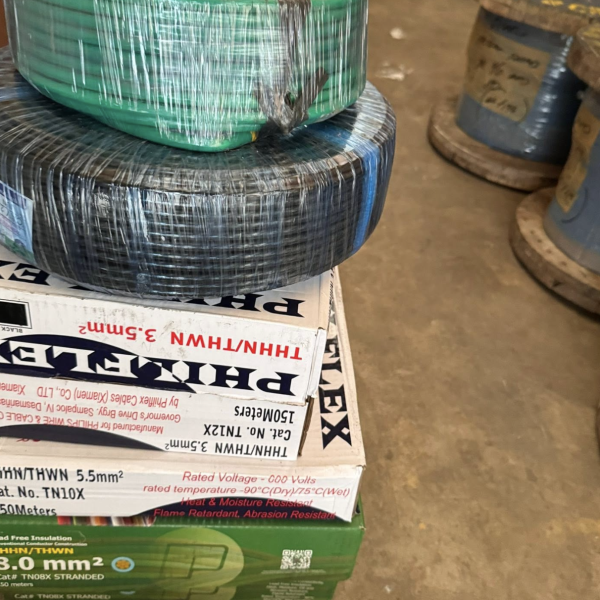
For standard residential branch circuits, lighting circuits, and service entrances in Philippine homes, THHN/THWN-2 dual-rated wire is the industry standard and the most cost-effective compliant choice. Typical sizes: 2.0mm² (for lighting), 3.5mm² (for outlets/receptacles), 5.5mm² (for air conditioning units), 8.0mm² (for cooking ranges/large appliances).
Install in: PVC conduit (UPVC or CPVC) or EMT metallic conduit per PEC requirements. Never install THHN without conduit in Philippine residential construction.
Commercial Buildings (Office, Retail, Restaurants)
Best Choice: THHN/THWN-2 for branch circuits; XLPE for feeders
Commercial buildings typically use THHN/THWN-2 for branch circuits and XLPE for main feeders and risers. XLPE’s lower fire toxicity and superior performance make it the recommended choice for feeder cables in multi-story commercial buildings. For enclosed malls and high-rises, XLPE (or LSZH variants) should be specified for all feeder and riser applications.
Industrial Facilities (Factories, Warehouses, Manufacturing Plants)
Best Choice: XLPE (XHHW-2)
Industrial environments — manufacturing plants in Laguna, warehouses in Cavite, cold storage facilities in Bulacan — demand the superior thermal, chemical, and mechanical performance of XLPE cable. Industrial motor leads, panel feeders, VFD (Variable Frequency Drive) cables, and power distribution in industrial settings should all specify XLPE.
Underground Conduit Wiring
Best Choice: THWN-2 minimum; XLPE preferred
Any wire installed in underground conduit in the Philippines must carry a wet-location rating. THWN-2 meets the minimum requirement. For critical underground feeders, particularly in areas prone to conduit flooding (common in Manila’s aging underground infrastructure), XLPE is strongly preferred for its superior moisture resistance and longevity.
Outdoor Service Entrances
Best Choice: THWN-2 or XLPE
Service entrance conductors exposed to outdoor weather must be moisture-rated. THWN-2 is acceptable; XLPE is preferred for long-term durability, especially in typhoon-exposed coastal locations.
Cold Storage Facilities
Best Choice: XLPE
Cold storage facilities subject wiring to rapid and extreme temperature cycling. XLPE’s thermoset chemistry maintains its flexibility and insulating properties across a wide temperature range — from -40°C to +90°C — making it the only sensible choice for refrigerated warehouse wiring.
Solar PV and Renewable Energy Systems
Best Choice: XLPE (UV-rated / USE-2)
Solar installations on Philippine rooftops and in solar farm developments require cables that resist prolonged UV exposure, heat, and outdoor environmental stress. XLPE-based USE-2 or PV Wire is the industry standard for solar applications.
Hospitals and Healthcare Facilities
Best Choice: XLPE (Hospital Grade)
Healthcare facilities require the highest standards of electrical safety, including fire-safe cable materials. XLPE (XHHW-2) is classified as Hospital Grade by UL and should be specified for all hospital, clinic, and medical center electrical installations in the Philippines. The reduced fire toxicity of XLPE protects patients, staff, and sensitive medical equipment.
9. Price Comparison in the Philippine Market (2025–2026)
Understanding wire pricing helps project managers make informed budget decisions. Here is a general price reference for the Philippine market:
THHN/THWN-2 Wire — Approximate Philippine Market Prices
| Size | Price Per Meter (Approx.) | Typical Use |
|---|---|---|
| 2.0mm² (14 AWG) | ₱18 – ₱25 | Lighting circuits |
| 3.5mm² (12 AWG) | ₱28 – ₱38 | Outlet circuits |
| 5.5mm² (10 AWG) | ₱45 – ₱60 | AC circuits |
| 8.0mm² (8 AWG) | ₱70 – ₱100 | Sub-panels, large appliances |
| 14.0mm² (6 AWG) | ₱120 – ₱170 | Feeder circuits |
| 22.0mm² (4 AWG) | ₱190 – ₱260 | Main feeders |
| 38.0mm² (2 AWG) | ₱320 – ₱450 | Service entrances |
| 60.0mm² (1/0 AWG) | ₱530 – ₱700 | Heavy feeders |
| 100.0mm² (3/0 AWG) | ₱850 – ₱1,200 | Industrial mains |
Prices are approximate retail market ranges and subject to change based on copper commodity prices, brand, and supplier.
XLPE Cable — Approximate Price Premium
XLPE cable typically commands a 20–35% price premium over equivalent-sized THHN/THWN-2 wire. For small projects, this cost difference is easily justified by XLPE’s superior performance and longer service life. For large industrial projects where thousands of meters of cable are specified, the choice between THHN/THWN and XLPE becomes a detailed total-cost-of-ownership analysis.
Key insight: In industrial applications where cable replacement involves significant downtime costs, XLPE’s extended service life (often 30+ years vs. 15–20 years for PVC-based wire in harsh Philippine environments) delivers compelling ROI.
Where to Buy Wire in the Philippines
Always purchase electrical wire from licensed, reputable suppliers who can provide:
- BPS (Bureau of Philippine Standards) PS Mark certification
- UL or IEC test reports for their products
- Traceable batch numbers for quality assurance
- Professional technical guidance on wire selection
Buying substandard or uncertified wire from informal channels is one of the leading causes of electrical fires in Philippine buildings — and it voids your electrical permit.
10. Common Mistakes Filipino Electricians and Contractors Make When Selecting Wire
Mistake #1: Using THHN in Wet Locations Without a Wet Rating
One of the most common (and dangerous) errors seen in Philippine installations is running THHN-only-rated wire through outdoor or underground conduit without confirming it carries a THWN wet-location rating. The dual rating THHN/THWN-2 should always be specified for any installation that might involve moisture.
Mistake #2: Over-Bundling Wires Without Derating
Philippine construction practice sometimes involves running many conductors in a single conduit without properly deration the ampacity per PEC Table 310.15. This leads to cables operating above their rated temperature, accelerating insulation degradation and creating fire hazards.
Mistake #3: Specifying THHN for Industrial Chemical Environments
Using THHN/THWN in environments with aggressive chemicals (common in Philippine food processing, pharmaceutical, and industrial manufacturing facilities) without recognizing that PVC insulation has chemical resistance limits is a costly error. XLPE should be specified for such environments.
Mistake #4: Ignoring Ambient Temperature Derating
Given Philippine ambient temperatures, any conduit installation must have its ampacity derated. Failing to apply correction factors for Philippine temperatures (regularly 35–40°C) results in overloaded wiring that fails prematurely.
Mistake #5: Buying Uncertified or “Gray Market” Wire
Counterfeit or substandard wire is a known problem in the Philippine electrical supply market. Always demand PS Mark or ICC certification from your supplier. At ETCZ Corp, every wire product in our supply chain is sourced from certified manufacturers with full documentation.
Mistake #6: Using a Single Wire Type for All Applications
A “one wire fits all” approach is never appropriate. The right wire for a bedroom lighting circuit is not the right wire for an industrial motor feeder or an underground distribution cable. Always match the wire specification to the application, environment, and PEC requirements.
11. ETCZ Corp: Your Expert Partner for Electrical Wire Supply and Installation in the Philippines
When it comes to electrical projects — from residential renovations in Antipolo to full-scale industrial installations across Luzon — ETCZ Corp is the partner you can trust.
Headquartered in Antipolo City, Rizal, ETCZ Corp has built its reputation as one of the most trusted electrical service providers in the region, backed by over 30 years of combined experience in electrical engineering, supply, and installation across the Philippines.
What Sets ETCZ Corp Apart
End-to-End Electrical Solutions: ETCZ Corp handles everything — from engineering design and wire/cable supply to installation, commissioning, and ongoing maintenance. You deal with one expert team for your entire project.
Industrial-Grade Product Supply: ETCZ Corp supplies industrial-grade wires, cables, breakers, lights, and accessories — all sourced from trusted brands that meet the highest safety standards, including BPS-certified THHN/THWN-2 and XLPE cables.
Licensed Electrical Engineers On Staff: All ETCZ Corp projects are led by licensed electrical engineers who ensure PEC compliance, proper wire selection, accurate load calculations, and safe installation practices.
Certified Energy Auditors: ETCZ Corp’s Certified Energy Audit capability means they don’t just install wire — they optimize your entire electrical system for energy efficiency, reducing your operating costs over the long term.
Philippine Electrical Code Compliance: ETCZ Corp handles all permits, inspections, and compliance documentation, ensuring your project passes CEI inspection on the first visit.
Free Initial Consultation: Not sure which wire type is right for your project? ETCZ Corp offers free initial consultations with professional engineers who can assess your needs and provide expert recommendations — at no cost to you.
Proven Track Record: From custom electrical panel boards and motor rewinding to VFD systems and electric meter applications, ETCZ Corp has delivered results for factories, warehouses, commercial facilities, and residential projects throughout Luzon.
12. Conclusion: Make the Right Wire Choice the First Time
Choosing between THHN, THWN, and XLPE cable isn’t a trivial decision — especially in the Philippines, where the combination of tropical heat, monsoon humidity, typhoon flooding, and strict PEC compliance requirements make wire selection a genuinely engineering-critical task.
Here’s the practical summary:
✅ Use THHN/THWN-2 for standard residential and light commercial wiring in dry or moderately wet indoor environments. It’s cost-effective, PEC-compliant, and widely available across the Philippines.
✅ Use THWN-2 (dual-rated) for any underground conduit, outdoor service entrance, or installation exposed to moisture. Never use unrated THHN in wet Philippine environments.
✅ Use XLPE (XHHW-2) for industrial applications, critical feeders, commercial buildings, hospital-grade installations, and any environment involving extreme temperatures, chemical exposure, coastal salt air, or rigorous long-term reliability requirements. XLPE’s superior performance in the Philippine climate makes it the professional’s choice for demanding applications.
The difference between a building that passes inspection first time, runs efficiently for 30 years, and stays safe through every typhoon season — and one that fails, overheats, or becomes a fire hazard — often comes down to this decision made during the design phase.
Don’t guess. Don’t cut corners. And don’t trust your project to an unverified supplier.
Get Expert Wire Guidance from ETCZ Corp — For Free
Ready to start your electrical project the right way?
ETCZ Corp — Antipolo’s most trusted electrical contractor and wire supplier — is ready to help you select the right cable, ensure full PEC compliance, and deliver your project on time and on budget.
Here’s What You Get When You Partner With ETCZ Corp:
✅ Free Initial Engineering Consultation — Talk to a licensed electrical engineer about your project at no charge
✅ Certified Wire & Cable Supply — Industrial-grade THHN/THWN-2 and XLPE cables from BPS-certified manufacturers
✅ End-to-End Project Delivery — Design, supply, installation, and commissioning under one roof
✅ 30+ Years of Combined Electrical Engineering Experience
✅ PEC-Compliant Installations with all permits and inspection certificates handled
✅ Nationwide Service — Based in Antipolo, Rizal; serving industrial and commercial clients across Luzon and beyond
Frequently Asked Questions
THHN stands for Thermoplastic High Heat-resistant Nylon-coated and is rated for 90°C in dry locations and 75°C in wet locations. THWN stands for Thermoplastic Heat and Water-resistant Nylon-coated, with THWN-2 being rated for 90°C in both dry and wet locations. In the Philippine market, most wire sold today is dual-rated THHN/THWN-2, which satisfies both standards in a single product. For wet or outdoor Philippine applications, always specify the THWN-2 rating.
Yes. XLPE (Cross-Linked Polyethylene) insulated wire, commonly specified as XHHW-2, is fully recognized and approved by the Philippine Electrical Code. It must carry appropriate BPS certification (PS Mark or ICC) and be specified correctly for the application. XLPE is particularly recommended in the PEC for feeders, industrial applications, and enclosed commercial buildings.
For underground conduit installations in the Philippines, the minimum requirement is THWN-2 dual-rated wire (with a wet-location rating). For critical feeders, long underground runs, or installations in flood-prone areas, XLPE (XHHW-2) cable is the preferred specification due to its superior moisture resistance and longer service life in wet environments.
XLPE cable is more expensive because its manufacturing process — the cross-linking of polyethylene — is more complex and materials-intensive than standard PVC extrusion. However, XLPE’s superior performance characteristics, longer service life, lower maintenance requirements, and better energy efficiency typically deliver a lower total cost of ownership over the life of an industrial or commercial electrical system.
Only if the THHN wire also carries a THWN or THWN-2 dual rating — which most modern THHN wire in the Philippine market does. It must also be installed in appropriate conduit that keeps the wire itself protected from direct weather exposure. For direct burial or installations where the cable itself is exposed to water, THWN-2 or XLPE is required.
Per the Philippine Electrical Code, minimum wire sizes for residential branch circuits are:
- 2.0mm² for 15A lighting circuits
- 3.5mm² for 20A small appliance and outlet circuits
- 5.5mm² for dedicated appliance circuits (air conditioners up to 1.5 HP)
- 8.0mm² for larger dedicated circuits (2–3 HP air conditioners, cooking equipment)
Always verify sizing with a licensed electrical engineer based on your actual load calculations.
In the Philippine industrial sector, XLPE is widely used for: main power feeders in manufacturing plants, underground distribution cables in PEZA economic zones, medium-voltage (3.3kV–33kV) distribution cables, motor feeder cables in demanding industrial environments, cold storage facility wiring, hospital-grade electrical systems, renewable energy (solar PV) installations, and typhoon-resistant aerial bundled conductor (ABC) systems.
Gallery
Why Choose ETCZ Corp for Your Electrical Wiring Needs in the Philippines?
At ETCZ Corp, we are not just electricians — we are licensed, certified electrical engineering professionals who are passionate about keeping Filipino homes and businesses safe, efficient, and code-compliant.
Here is what sets ETCZ Corp apart:
✅ Certified Electrical Engineers on every project — not just technicians
✅ FREE consultation before any project begins — we assess your needs before you spend a single peso
✅ PNS-certified materials only — we never compromise on wire quality
✅ Full PEC compliance — every installation is code-correct and documented
✅ Transparent pricing — no hidden charges, no surprises
✅ Residential, commercial, and industrial expertise — we handle it all
✅ Serving Antipolo, Rizal Province, and Metro Manila
✅ Post-installation support — we are with you long after the job is done
Whether you are building a new home in Antipolo, upgrading an aging electrical system in your commercial building, installing a cold storage facility, or planning for solar power integration — ETCZ Corp has the expertise, licensing, and passion to power your project the right way.

ETCZ Corp
Ready to Get Started?
Contact ETCZ Corp today for a FREE electrical consultation.
Our Certified Electrical Engineers are ready to assess your project, recommend the right wire types and sizes, and deliver a safe, code-compliant installation that lasts for decades.
🌐 Visit us: etczcorp.com
📍 Location: Antipolo, Rizal — serving Rizal Province and Metro Manila
📬 Message us directly through our website for a FREE quote

Call Now 09778411839
Have any queries?
We're here to help.
- #52 M.L Quezon St. Villa Ligaya Subdivision Barangay Dela Paz, Antipolo City
- 09778411839
- [email protected]